CANNING TOWN. Town Centre


A bit of history. Between Bow Creek and Barking Creek: Plaistow Marshes
Canning Town was founded in the first half of the 19th century on the eastern bank of the River Lea, just before it meets the Thames. In those days the Lea — known as Bow Creek — marked the border between London and Essex. Until the 19th century, the only way to reach the Essex side — then just a part of Plaistow marshes — was by boat.
Then, in 1810, an Act of Parliament was passed to allow the Barking Road to be built between East India Docks and Barking, by James Walker for the Commercial Road Turnpike Trust. This led to the construction of an iron bridge across the river with a tollgate nearby, and the development of Canning Town began.
Plaistow marshes were cut off from the rest of Essex by Barking Creek to the west, and were rich in bird life. The marshes had been used for centuries for grazing horses — most famously in the 18th century by the Duke of Cumberland, brother of George III — as well as for cattle.
The notorious 18th century-highwayman Dick Turpin began his career by stealing a pair of oxen from his employer in Plaistow: he later led a gang of smugglers who operated between the marshes and Southend.
People working on the marshes carried special poles fitted with a flat disc at one end to help them to jump over the many streams and drainage ditches. At the beginning of the 19th century there were less than 200 houses in the area, and the population of the whole of the borough of West Ham numbered less than 7000 people.
As part of Essex, businesses and homes on the eastern bank of the Lea were not covered by the much stricter London planning regulations introduced in the 1844 Metropolitan Building Act. This attracted to Canning Town what Charles Dickens described in 1857 as “offensive trade establishments …. oil-boilers, gut-spinners, varnish-makers, printers’ ink-makers and the like” (from “Londoners over the border” in Charles Dickens’ weekly journal Household Words). This included chemical companies and other foul-smelling industries. The shipbuilding company Thames Ironworks, founded in 1837 by shipwright Thomas J. Ditchburn and naval engineer Charles J. Mare, also became a major local employer after opening premises on the Essex side of the Lea in 1847.
In the mid-19th century, this desolate area was chosen for the massive Royal Victoria Dock, built on the marshes starting in the 1850s. The construction of the rest of the Royal Group of docks, followed by industrial expansion, led to the growth of Canning Town and Silvertown, replacing the marshes with docks, railways, and housing.
Hallville and Canning Town
In the beginning, Canning Town was divided into ‘Hallsville’ in the south (initially named ‘Plaistow New Town’), where the shipbuilding workers and their families were housed, and ‘Canning Town’ in the north, where the workers who were building the Royal Docks lived. In 1851, ‘Canning Town’ consisted of 60 houses in Stephenson Street, Wharf Street and Wharf Place, while ‘Hallsville” consisted of about 80 houses close to Victoria Dock Road. Canning Town, as the whole area soon became known, was possibly named after the 1st Viceroy of India, Charles John Canning —known as ‘Clemency Canning’ for his leniency in dealing with the Indian mutiny in 1857. However, Canning himself had no connection with East London and the name of the ‘town’ existed long before the mutiny.

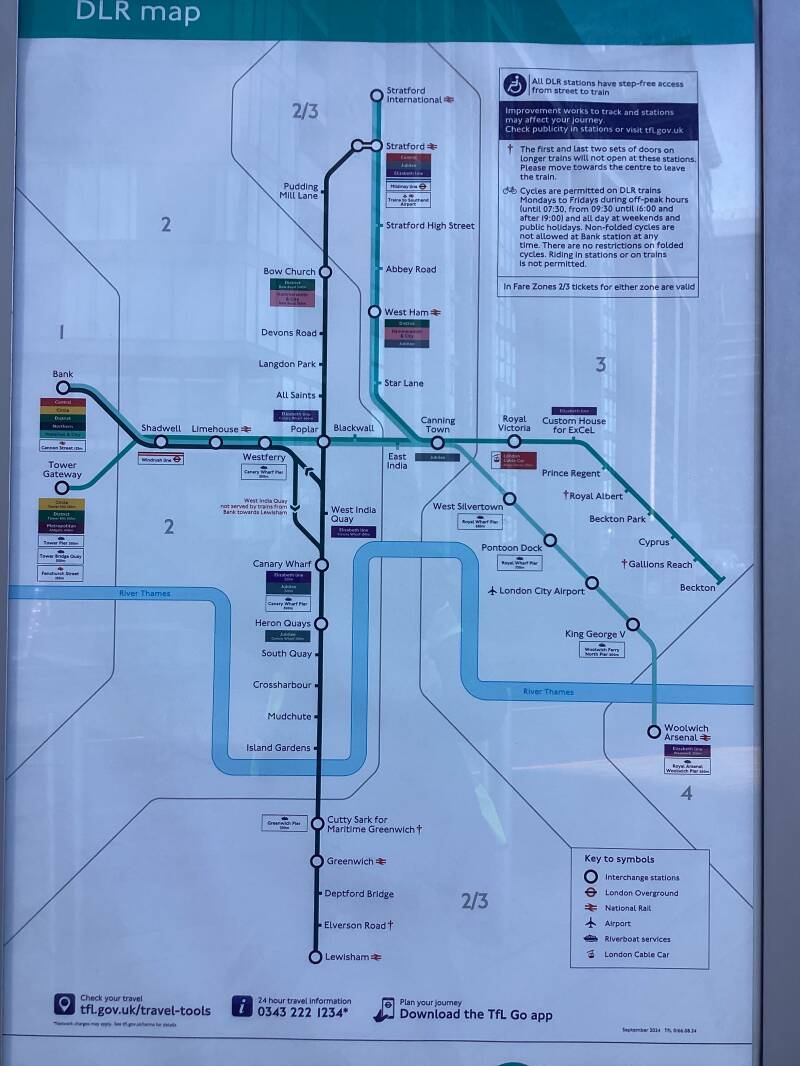
Canning Town L.U. and DLR Station
Alongside Barking Road
Former THE ROYAL OAK P.H.
Future King Charles II hid behind an oak tree, in 1651, during the BATTLE OF WORCESTER, fleeing the PARLAMENTARÍAN army.
Oak leaves and acorns, a rather biboulus face… and a couple of bunches of grapes. Remains of a fitting: a gas lamp?.
It was renowned for its boxing gym that trained champions like Frank Bruno.
Now a Turkish restaurant it was a notorious local spot with a boxing gym upstairs, known for its tough clientele and legendary boxing history
ST.MARGARET’s and ALL SAINTS R.C. Church
A Victorian Gothic brick building (1875-76) designed by F. W. Tasker, rebuilt after WWII bombing. Restored in 1949-51 by T.G.B. Scott
Gothic Revival, featuring yellow brick and a distinctive star-shaped rose window (a pentagram was a Pagan symbol, but 5 points symbolise the 5 wounds of JC).
A separate St. Margaret's Chapel, a listed interwar building (1929-31) by W. C. Mangan, was part of a convent but now stands alone after the convent was demolished, with its own distinct history. Both have roots in local Catholic missions, serving the growing East London community from mid 19th c.
CHAPEL in BETHEL AVENUE (See ROUTE from ROYAL DOCKS to WEST HAM): https://taking-stock.org.uk/building/canning-town-st-margarets-chapel/#:~:text=The%20foundation%20stone%20was%20blessed,high%20convent%20boundary%20wall%20survives.
Former ANCHOR HOUSE, now YOUR PLACE
Your Place is a charity dedicated to solving homelessness in east London, one person at a time. We’re here to offer hope, a home and a healing place to grow, where people who’ve lost their homes can get the individual support they need within a safe, caring community.
Until recently, Your Place was known as Caritas Anchor House. Over the years we’ve evolved from an east London charity with a specific maritime mission into a growing, forward-thinking organisation with an ambitious, far-reaching purpose: to solve homelessness, one person at a time.
Established in 1962 by the Catholic London Inter-Diocesan Council of the Apostleship of the Sea, the charity provided temporary accommodation to out-of-work seafarers coming in and out of the nearby docks.
As London’s industrial landscape changed and the London Docks closed, fewer and fewer seafarers were seeking help. So, in the 1990s we began operating as a dedicated residential and support service for people experiencing homelessness in east London, regardless of their background.
RATHBONE MARKET
Rathbone Market can trace its origins back to 1253, when King Henry III promised a Wednesday market in West Ham ‘forever’.
Until the nineteenth century, the market thrived in Victoria Dock Road, but the introduction of tramlines meant it needed to find a new home. This new home was Rathbone Street, Canning Town, from which the market takes its name. The market – which was particularly known for its herbalists – continued to prosper in its new location, at times stretching for nearly a quarter of a mile along Rathbone Street.
In 1963, the local council moved the market to its current site, just off the Barking Road. At its peak, the market had 160 stalls, as well as specialist second hand clothes, textiles and bric-a-brac markets. Every year, a major market was held on Good Friday, attracting hundreds of traders and many thousands of shoppers.
In 2009, planning consent was granted for the redevelopment of the Rathbone Market site to include over 600 new homes, shops, a library and community centre and a new market square.
This new market square opened in 2015.
Former PUBLIC LIBRARY. Now,
redevelop and refurbish the Grade II listed building as a new hub for heritage and digital learning, a process which involves close consultation with the local community. The Victorian library is historically significant having played an important role in the creation of the trade union movement in Britain.
ELEANOR MARX-AVELING
- Speaking Engagements: Eleanor Marx was a prominent socialist and suffragette speaker, and she spoke at the Public Hall alongside other notable figures such as Sylvia Pankhurst and Keir Hardie.
- Trade Union Work: She was instrumental in assisting trade unionist Will Thorne to establish the National Union of Gasworkers and General Labourers in 1889. The union was effectively founded after a mass meeting at this location.
- Women Workers' Rights: Eleanor Marx was a tireless advocate for women's rights in the workplace. She helped organize the first women workers' branch of the Gasworkers' Union and was actively involved in the a 12-week strike at the nearby Silver's factory in Silvertown.
- Commemoration: A plaque honouring Eleanor Marx's work and association with the labour movement was erected at the site of the former library/public hall.

A small detour
GANDHI CHAPLIN MEMORIAL GARDEN
A famous meeting in 1931
The meeting between Mahatma Gandhi and Charlie Chaplin took place on September 22, 1931, in Canning Town, East London, at the home of a local doctor, Dr. Chuni Lal Katie, 45 Beckton Road, Canning Town, E16 4EA. The house has since been demolished, but the general area is commemorated by the Gandhi Chaplin Memorial Garden.
Dr. Chuni Lal Katial was a friend of Gandhi's and a public health pioneer who ran a practice in a working-class neighborhood. He later became the UK's first South Asian mayor.
Gandhi was in London to attend the Second Round Table Conference on Indian constitutional reform and was staying nearby at Kingsley Hall in Bow. Chaplin was in London for the premiere of his film City Lights.
CHAPLIN had a strong desire to meet GANDHI. Gandhi initially did not know who Chaplin was and was hesitant to meet, but was persuaded by his acquaintances (including Muriel Lester, his hostess at Kingsley Hall) who described Chaplin as a "world's hero" who understood the poor.
The two men, two of the most famous figures in the world at the time, finally had that encounter, during which they discussed a variety of topics for about an hour, primarily focusing on the negative impacts of industrialization and machinery.
This conversation is widely cited as one of the key influences for Chaplin's classic film Modern Times, which satirized the dehumanizing effect of automation and factory life.
The event was a major spectacle, with hundreds (some reports say thousands) of people gathering outside the "humble little house" to catch a glimpse of the two celebrities. Newspaper photos of the meeting made front-page news the next day.
Chaplin
Charlie Chaplin's alignment with leftist ideals developed gradually, beginning with an ingrained empathy for the working class rooted in his impoverished childhood and becoming more overt in his films and public statements during the 1930s and 1940s.
Chaplin was born into extreme poverty in London and spent time in a workhouse as a child, which instilled a lifelong compassion for the downtrodden. These experiences influenced his iconic character, the Tramp, which he began developing in the mid-1910s. His early films with Mutual Film, such as The Immigrant, began to subtly explore themes of urban poverty and economic inequality in the late 1910s. During a visit to New York in the early 1920s, he socialized with self-styled socialist intellectuals, which further shaped his political views.
Chaplin's politics became more explicit during the Great Depression and the rise of fascism in the 1930s.
Modern Times (1936): This film was a clear social commentary, opening with a shot of workers being compared to sheep, a critique of industrialization and the systemic struggles of the working class.
The Great Dictator (1940): Chaplin's first "talkie" was a bold, anti-fascist satire directly targeting Hitler and Mussolini when the U.S. was still officially neutral in the war.
His anti-establishment and humanist works, along with friendships with socialists like H.G. Wells and Max Eastman, drew attention. In December 1942, Chaplin famously stated, "I am not a Communist, but I am proud to say that I feel pretty pro-Communist" because of their stance against fascism during World War II.
His views and refusal to become an American citizen made him a prime target during the McCarthy era. The FBI launched an extensive investigation into his life and alleged Communist ties, and in 1952, while Chaplin was traveling to London for a film premiere, his reentry permit to the United States was revoked, leading to his exile in Switzerland.
The three Round Table Conferences of 1930–1932 were a series of peace conferences, organized by the British Government and Indian political personalities to discuss constitutional reforms in India.[1] These started in November 1930 and ended in December 1932. They were conducted as per the recommendation of Muhammad Ali Jinnah to Viceroy Lord Irwin and Prime MinisterRamsay MacDonald,[2][3] and by the report submitted by the Simon Commission in May 1930. Demands for Swaraj or self-rule in India had been growing increasingly strong. B. R. Ambedkar, Jinnah, Sir Tej Bahadur Sapru, V. S. Srinivasa Sastri, Sir Muhammad Zafrulla Khan, K. T. Paul and Mirabehn were key participants from India. By the 1930s, many British politicians believed that India needed to move towards dominion status. However, there were significant disagreements between the Indian and the British political parties that the Conferences would not resolve. The key topic was about constitution and India which was mainly discussed in that conference. There were three Round Table Conferences from 1930 to 1932.
After the failure of the First Round Table Conference, the British recognized they needed the participation of the Indian National Congress. On January 26, 1931, Gandhi and other Congress leaders were freed from prison. The resulting discussions culminated in the Gandhi–Irwin Pact (1931) under which the Congress agreed to participate in a Second Round Table Conference.
Gandhi was invited from India and attended as the sole official Congress representative accompanied by Sarojini Naidu and also Madan Mohan Malaviya, Ghanshyam Das Birla, Muhammad Iqbal, Sir Mirza Ismail (Diwan of Mysore), S.K. Dutta and Sir Syed Ali Imam. Gandhi claimed that the Congress alone represented political India; that the Untouchables were Hindus and should not be treated as a “minority”; and that there should be no separate electorates or special safeguards for Muslims or other minorities. These claims were rejected by other Indian participants.
WESTMINSTER. METHODIST CENTRAL HALL
a historic London venue where Mahatma Gandhi spoke in 1931, addressing the Temperance League in its Library. This iconic building, built as a memorial to John Wesley, also hosted significant events like the first UN General Assembly in 1946 and speeches by Churchill and Martin Luther King Jr., serving as a church, conference centre, and iconic London landmark. a historic London venue where Mahatma Gandhi spoke in 1931, addressing the Temperance League in its Library. This iconic building, built as a memorial to John Wesley, also hosted significant events like the first UN General Assembly in 1946 and speeches by Churchill and Martin Luther King Jr., serving as a church, conference centre, and iconic London landmark.
Surviving Victorian terrace houses

Towards Barking Road

Towards the ROYAL DOCKS (BECKTON DISTRICT PARK, or along Victoria Dock Rd. and crossing over the railway track -ROYAL VICTORIA and CUSTOM HOUSE Stations)

Back to Canning Town centre: ST.LUKE’s Church
FAIRBARN HALL
An historic Grade II listed building originally built as the Mansfield House University Settlement in the late 1890s, part of Oxford University's settlement movement to provide social & educational services in East London, later becoming a Boys' Club and now converted into unique apartments, preserving its modernist architecture and legacy of community integration.
A settlement brought students to live among working-class residents in East London for mutual understanding and welfare. It housed workshops, a gym, theatre, canteen, library, and more for community use.
Designed by F.W. Troup (1897-98) and later refurbished by George Grey Wornum, it features modernist elements like vaulted ceilings and Crittall windows. In the 1970s/80s, it became a boxing club before its conversion into housing.
n
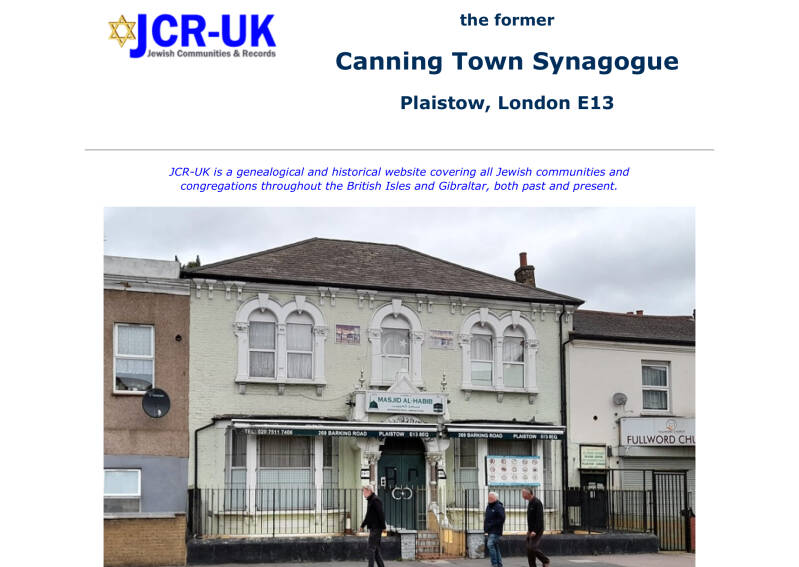
269 Barking Rd. Former SYNAGOGUE, now a MOSQUE
MEMORIAL COMMUNITY CHURCH
The church was originally founded in 1871 as the Barking Road Tabernacle. the preceding building is still extant on Barking Road closer to Canning Town. This was in continuing debt until Robert Rowntree Clifford took over in 1897, reviving and transforming the church membership and clearing all the debts by 1900. Growth led to the formation of West Ham Central Mission in 1904. This ran alongside the church until its present building opened in 1922.[
Designed by William Hayne, its construction had taken 15 months, costing about £60,000.
It was constructed in the Byzantine style with a domed auditorium and two towers, and was dedicated to men from the local community and the congregation who had died in World War I. In 1924 the church received the gift of a new organ from Dame Clara Butt. The organ is of particular interest having been built by R. Spurden-Rutt as their first instrument using electric action. The bells in the East tower were cast by Gillett & Johnston with the names of 169 local men lost in the First World War cast into them. One bears the name of Prince Maurice of Battenberg, the only member of the British royal family killed in action in the "Great" War, and one is dedicated to the Unknown Warrior. The bells were dedicated in 1926 at a service including a performance by the baritoneKennerley Rumford.
In the New Year Honours of 1938, Robert Rowntree Clifford's wife, Hettie, received the OBE for her efforts as superintendent of the women's work of the Mission.
In 1978, a new trust deed changed the name of the Mission to Memorial Baptist Church Plaistow.[2] The Memorial Community Church was formed in 2006 when the congregation of St Andrew's Church, Plaistow merged into the congregation of Memorial Baptist Church to form one group

Back to CANNING TOWN centre
South of Newham Way
KEIR HARDIE PARK
ST.LUKE’s Church
RIVER CHURCH
GROW BOX. Planting seeds of opportunity
REGENERATION: https://newhamco-create.co.uk/en/folders/cter
STREETIES P.H.
The Glass House
CAXTON WORKS
Studio Egret West are the architects for Caxton Works, which won the “Best Built Mixed-Use Scheme” at the 2018 New London Awards for its integration of housing and light industry. As part of the LFA 2019, they invite you to join them on a guided walking tour of this co-location project.
In Greater London, 604ha of industrial land has been lost in the last decade, with the result that there is now a shortage of affordable business space and less space for workshops and artists’ studios. While the pressure on industrial land is understandable, we believe that new communities should be providing places for people to both live in and work in. Caxton Works in Canning Town seeks to reverse this trend, combining 336 homes above light industrial spaces which are designed to attract businesses in need of affordable work space. The project embraces densification whilst creating an authentic identity that is a defined by the symbiosis of previously conflicting uses, helping to define the area between Canning Town centre and the docks as a successful and innovative employment-led mixed-use neighbourhood.
Subway under Silvertown Way

HALLSVILLE QUARTER: total regeneration!
Wonderful women of NEWHAM
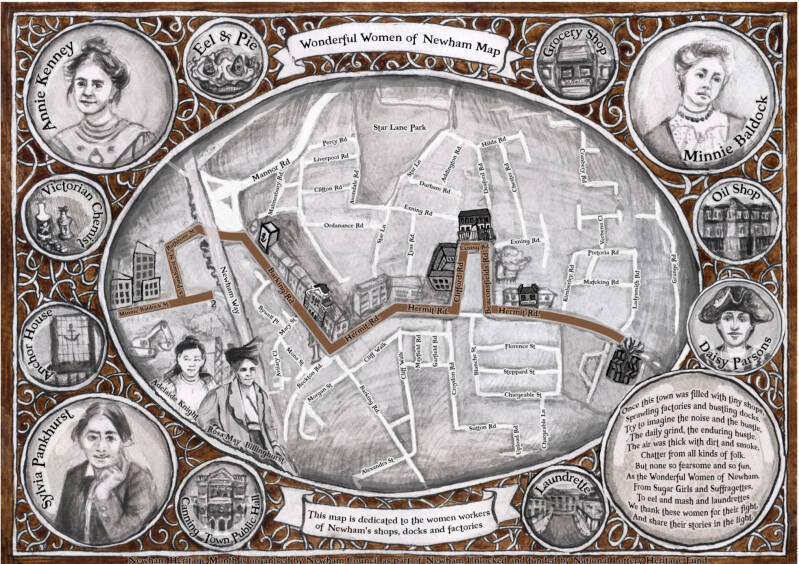
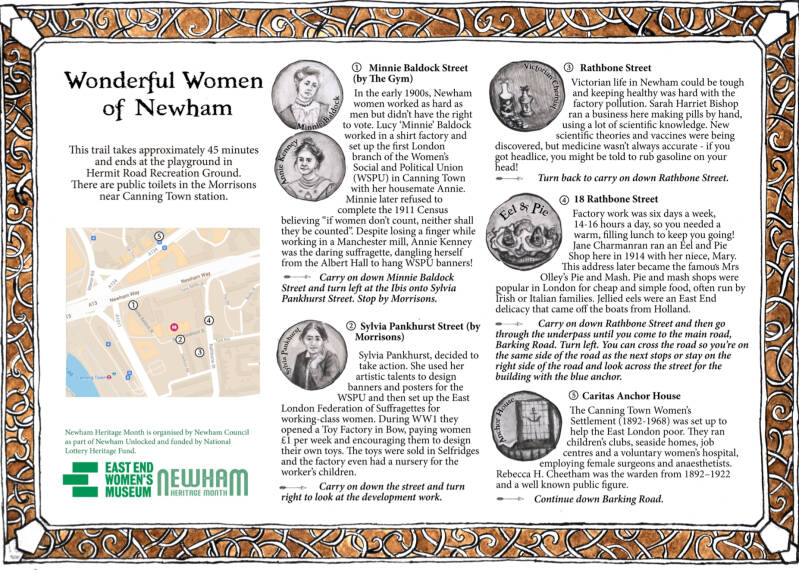
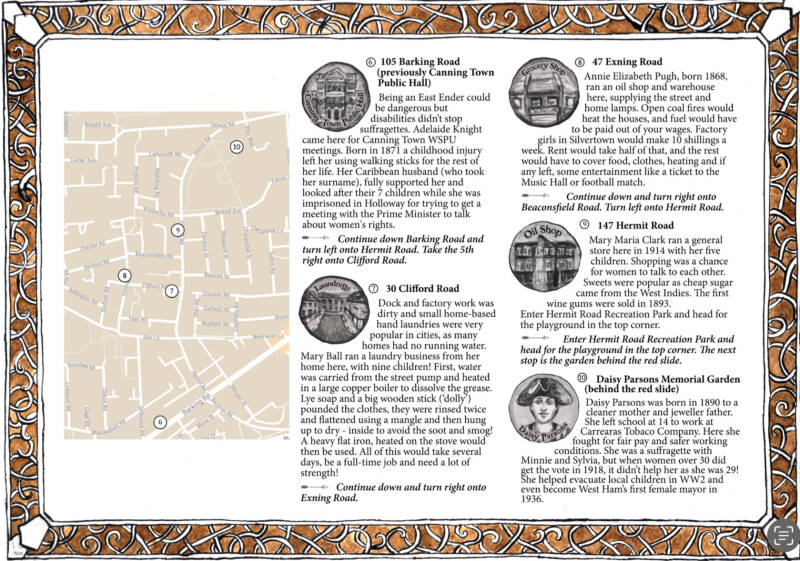
A few suggestive street names…
MINNIE BALDOCK, the working class suffragette
1864–1954. A was a prominent working-class activist who established the Canning Town branch of the Women's Social and Political Union (WSPU) on January1906 (the very first branch to be founded in London).
Baldock co-founded the Canning Town branch with fellow activist Annie Kenney. The branch initially formed from the Unemployed Women of South West Ham group, which voted to join the WSPU following a speech by Kenney.
Baldock served as a salaried organiser for the WSPU, traveling across England to recruit members and support the cause.
She was arrested in February 1908 during a demonstration outside Parliament and sentenced to one month in Holloway Prison.
Adhering to the WSPU slogan "if women don't count, neither shall they be counted," she boycotted the 1911 Census.
After a battle with cancer and surgery in 1910, Baldock drifted away from the WSPU in 1911. This was partly due to her health and partly due to growing disillusionment with the movement's increasingly militant and authoritarian direction, which she felt marginalized working-class concerns.
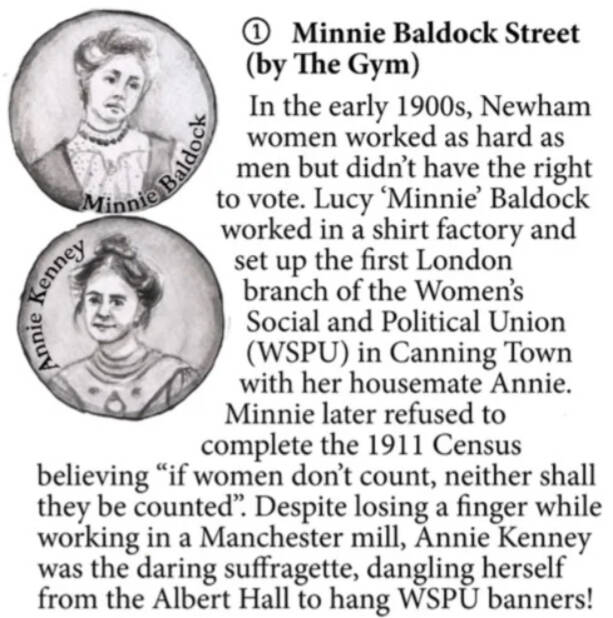
SYLVIA PANKHURST, the leader
NORAH SMITH, photographer, activist
Smyth, a suffragette, socialist and pioneering female photographer was a founding member of the East London Federation of Suffragettes (ELFS) and right-hand woman to Sylvia Pankhurst, who set up the federation in 1914.
Her years of activism included a spell as a prominent member of the Communist Workers’ Party (CWP) during the 1920’s. Her active participation in the international socialist movement came to an end with the dissolution of the CWP. After twelve years in the East End of London, it was time to move on. Smyth decided to join brother Maxwell in Florence, where she took up a post at the British Institute.
Jane McChrystal. “The adventures of Norah Smyth: her life as a suffragette, philanthropist and artist,” on the Roman Road LDNwebsite 22 March 2023 [Online] Cited 04/08/2023
Smyth, a suffragette, socialist and pioneering female photographer was a founding member of the East London Federation of Suffragettes (ELFS) and right-hand woman to Sylvia Pankhurst, who set up the federation in 1914.
Her years of activism included a spell as a prominent member of the Communist Workers’ Party (CWP) during the 1920’s. Her active participation in the international socialist movement came to an end with the dissolution of the CWP. After twelve years in the East End of London, it was time to move on. Smyth decided to join brother Maxwell in Florence, where she took up a post at the British Institute.
Jane McChrystal. “The adventures of Norah Smyth: her life as a suffragette, philanthropist and artist,” on the Roman Road LDNwebsite 22 March 2023 [Online] Cited 04/08/2023
SUFFRAGETTES
Bow was the headquarters of the East London Federation of the Suffragettes. Led by Sylvia Pankhurst, it was an offshoot of the ‘Women’s Social and Political Union’. Sylvia was the daughter of Emmeline and sister of Christabel. She was a campaigner for more than just the vote. She opened a nursery, a cost-price restaurant and a co-operative toy factory. All with view to try and improve the conditions of the women of the East End. This was one of the country’s most deprived areas.
A vocal advocate for working class women. She also published a newspaper called the Woman’s Dreadnought. The name Sylvia Pankhurst became well known as she would speak out across East London. This was much to the ire of the authorities. Pankhurst was arrested and sent to prison eight times between 1913 and 1914. There she would suffer force feeding on each occasion.
EAST END POVERTY: https://artblart.com/tag/spitalfields-market/
Rathbone St.

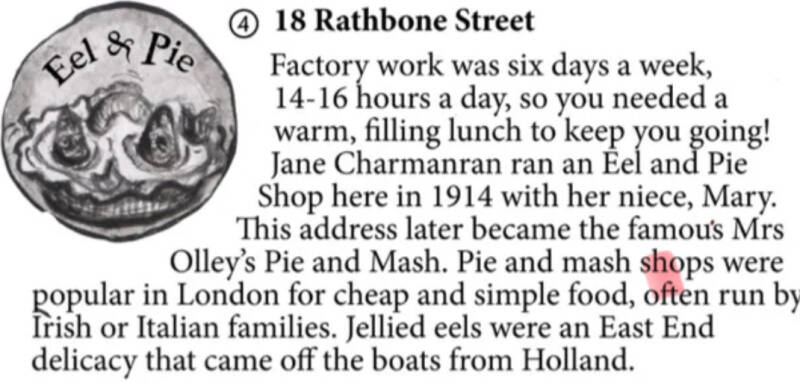

Would you like to help?