From the LONDON CABLE CAR to the WOOLWICH FREE FERRY, along the North quays of ROYAL VICTORIA and the ROYAL ALBERT DOCKS
Sights along this route: *CITY HALL *CABLE CAR *VICTORIAN WAREHOUSES *ARTWORK *EXCEL, TRADE EVENTS CENTRE *PORT OF LONDON 1914 REFRIGERATION STORE*LONDON BOROUGH OF NEWHAM OFFICES *UNIVERSITY OF EAST LONDON CAMPUS *PUMPING STATION
The Port of London… London’s Docklands


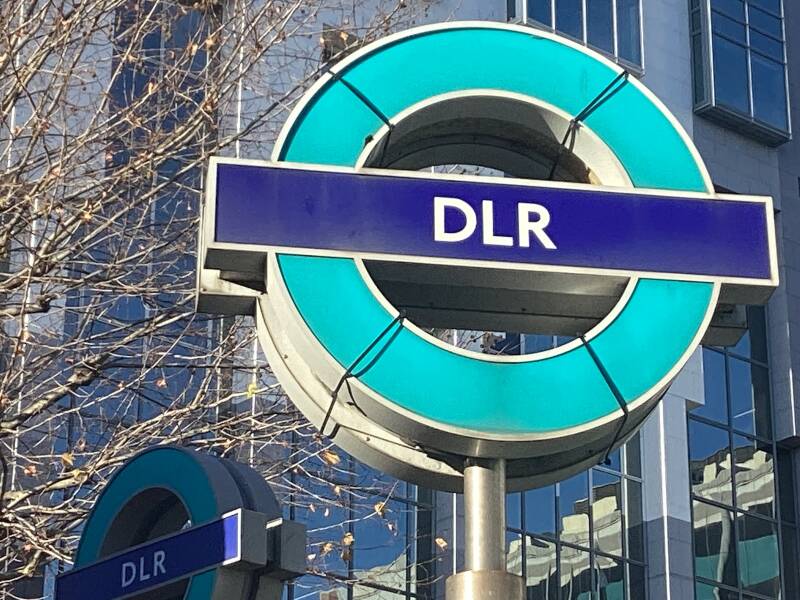
Royal Victoria DLR Station
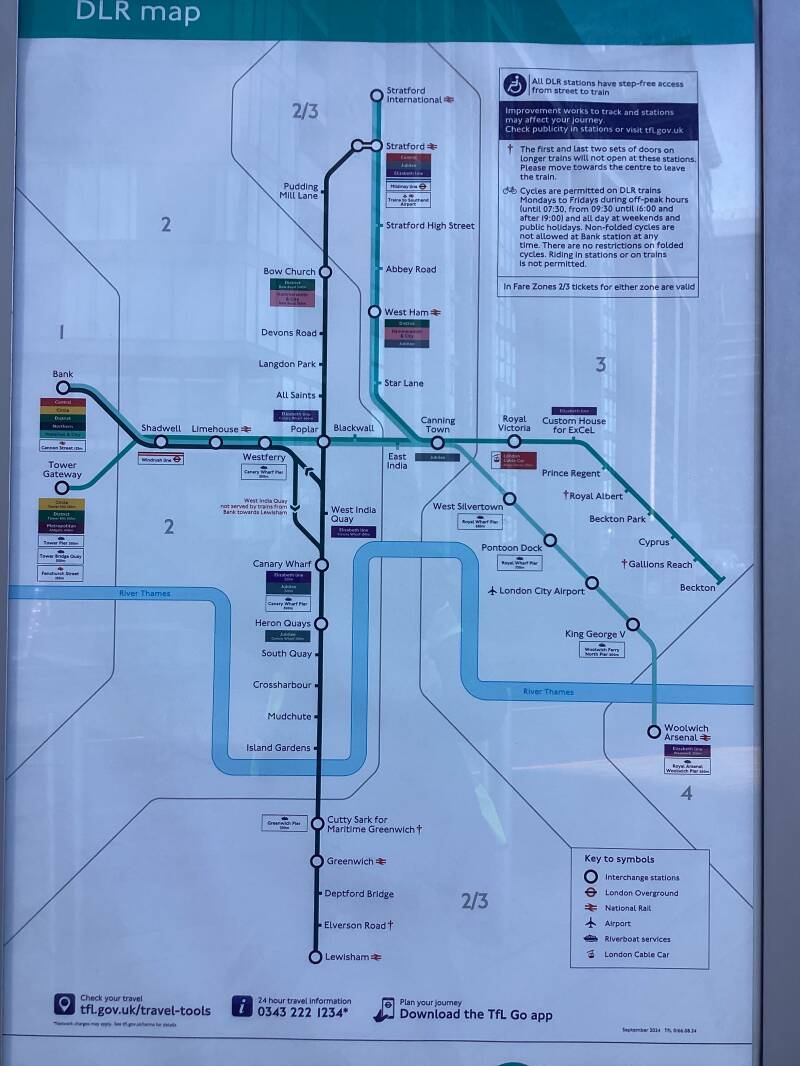

Cycles SHUTTLE BUS to North Greenwich along the SILVERTOWN TUNNEL


Seagull Lane
The Pumphouse. Creative studios and The Freight café
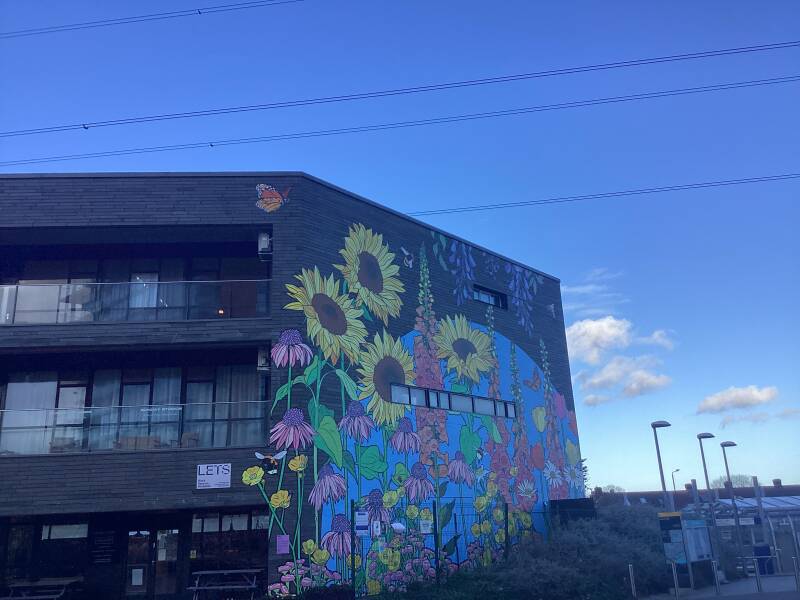
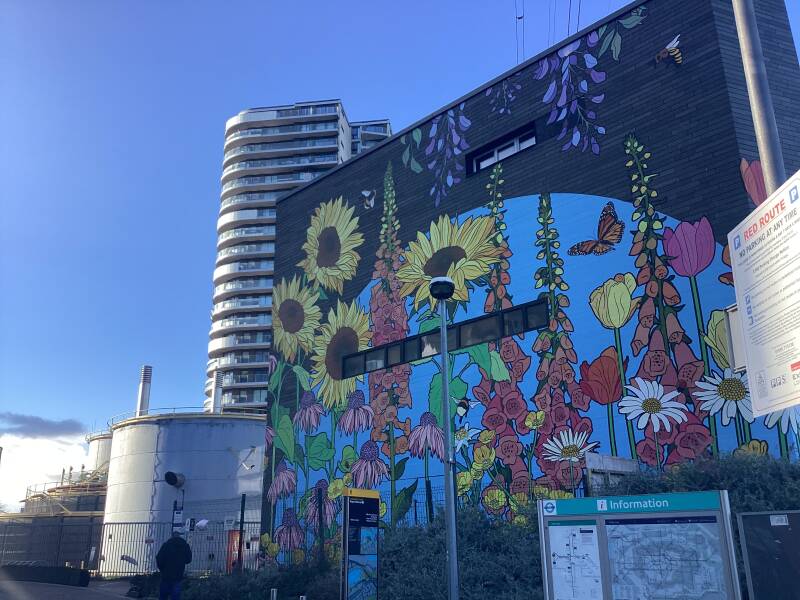
STORM-WATER PUMPING STATION

One of the storm-water pumping stations around the docks, and the surface structure conceals the majority of the infrastructure which extends 25 metres below ground level. There are some interesting diagrams and photos of the pumping station here.
The blue painting of the circular structures is now rather faded. When completed, this was a deep blue, with red and yellow for additional features of the station.
These colours were chosen as “from the outset the building was meant to be a visual delight, an oasis in the drab industrial environment of Silvertown”.
Much of the area around the Royal Victoria Dock has changed considerably in the years since there pumping station was completed, and there is not that much of the “drab industrial environment” left.
RICHARDS ROGERS https://rshp.com/practice/
City Hall and Cable Car

LONDON MAYOR and LONDON ASSEMBLY
The Mayor of London plans and policies for the capital cover: Arts & Culture, Business & Economy, including attracting foreign Investment, Environment, Fire, Health, Housing and Land, Planning, Policing & Crime, Regeneration, Sport, Transport, Tourism and attracting events and conferences to London, Young People include higher education.
The GL Mayor is the most powerful directly-elected politician in the UK, being held publicly and democratically accountable.
The Assembly examines the Mayor’s decisions and actions to ensure promises to Londoners are delivered.
The 25 London Assembly Members are elected at the same time as the Mayor. Eleven represent the whole capital and 14 are elected by constituencies.
Western Gateway
Hotels, eateries, convenience stores

Along the Royal Victoria Dock
The ROYAL GROUP OF DOCKS: A bit of History
ROYAL VICTORIA DOCK
Although, the structure was in place in the year 1850, it was opened in 1855, on a previously uninhabited area of the Plaistow Marshes. It was the first of the Royal Docks and the first London dock to be designed specifically to accommodate large steam ships. It was also the first to use hydraulic power to operate its machinery and the first to be connected to the national railway network, via the Eastern Counties and Thames Junction Railwaysection of what is now the North London line.[1] It was initially known as "Victoria Dock"; the prefix "Royal" was granted in 1880.
The dock was an immediate commercial success, as it could easily accommodate all but the very largest steamships. By 1860, it was already taking over 850,000 tons of shipping a year – double that of the London Docks, four times that of St Katharine Docks and 70% more than the West India Docks and East India Dockscombined. It was badly damaged by German bombing in the Second World War, but experienced a resurgence in trade following the war. From the 1960s onwards, the Royal Victoria experienced a steady decline
The ROYAL DOCKS, now
THE GOOD HOTEL. Floating SOCIAL-ENTERPRISE Hotel

Not-for-profit hotel on the Royal Victoria Dock that provides training to unemployed locals.
From the Netherlands to London: https://goodhotel.co/floating-hotel
Quayside eateries and street food
The Heroica Lounge

It previously operated as a sightseeing bus in Hong Kong.
As for the name "Heroica," it draws inspiration from Cartagena's historic significance. On November 11, 1811, Cartagena boldly declared its independence from Spain, becoming the first Colombian city to do so. This courageous act earned Cartagena the esteemed moniker of "La Heroica," or "the Heroic City," a title commemorated with festivities throughout the entire month of November.
Quayside apartments
Foot bridge
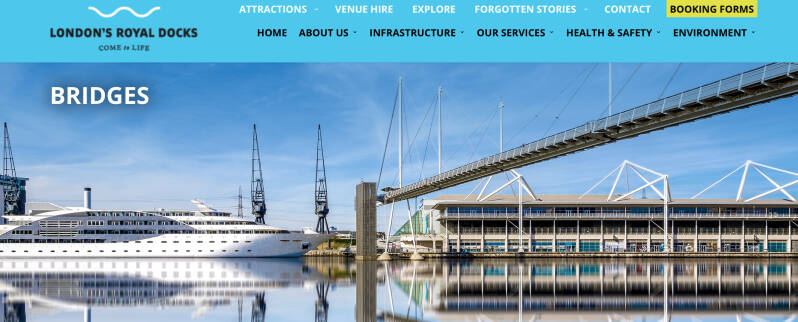
A signature high-level footbridge crossing the Royal Victoria Dock in the Docklands area of east London designed by London-based architects and designers Lifschutz Davidson Sandilands. The bridge provides a direct link from Eastern Quay and Britannia Village, a residential development to the south of the dock, to the ExCeL Exhibition Centre and Custom House station, both situated to the north of the dock.
. The shape of the bridge is designed to reflect the masts of the sailing boats which use the dock. The bridge crosses the dock with a clearance of some 15 m (50 ft) above the water, a height which was necessary to allow yachts to pass below the bridge deck.
The bridge was completed in 1998, at a cost of £5 million.[2] A second construction stage envisaged in the bridge's design involves the addition of a glass passenger cabin travelling on a rail of the underside of the deck to make this a transporter bridge
SUNBORN YATCH HOTEL
The Sunborn yacht hotel concept was pioneered in 1998 by Finnish entrepreneur Hans Niemi and is a privately owned company that built the first floating hotel in Naantali, Finland. The first Sunborn yacht hotel to arrive in London opened in 2003, but was replaced in 2014 by a larger, second-generation vessel after the original was sold to the Lagos government. There is also a sister hotel in Gibraltar, which opened in 2014.
“LANDED”, an homage to the DOCKERS artwork
The sculpture depicts dockers at work as goods are moved from a hoist to a sack barrow. The three figures are modelled on real people - John Ringwood pushing the barrow, Patrick Holland shown as the tally clerk, and Mark Tibbs kneeling.
Ringwood, who initiated the idea of the statue, was among dozens of former dock workers who attended the ceremony, along with Newham councillors and VIPs.
At 9ft high, the work is one of the largest figurative sculptures in London. More than £250,000 was raised to pay for it, the most high-profile contributor being the Queen Mother, who felt a special affection for East Enders.
This is one of the statues 'collected' by Londonist in their interesting piece about working class statues, though they left out the Three Printers.
Figures in the Mile End mural are based on this statue. Though in the mural the tally clerk is shown as a black man.
”This sculpture has been erected as a tribute to the history of the communities of the Royal Docks and the men and women who worked there from 1855 - 1983. Funded by a charitable appeal supported by the Royal Docks Trust (London).
www.royaldockstrust.org.uk
Sculptor - Les Johnson
Bronze Age Foundry
2009”
With thanks to London Remembers: https://www.londonremembers.com/memorials/dockers-statue-john-ringwood
Converted GRAIN WAREHOUSES
The RRDD once featured a range of historic grain and general cargo warehouses. A surviving set of these structures are the Warehouses K to R along the north side of the Royal Victoria Dock.
These buildings were originally part of the warehousing facilities built for the Victoria Dock, completed in 1858. They were designed to handle the massive influx of cargo, especially foodstuffs like grain, that made the Royal Docks London's primary port in the early 20th century.
- Warehouse K, specifically, dates to around 1850-55 and is a Grade II listed building. It is a stock brick building with three storeys, featuring iron-framed windows and internal construction with iron columns and timber-sandwiched beams.
- Current Status: All of the original Victoria Dock warehouses (K through R) and a free-standing Warehouse W are the only ones that survive today. Many have been adaptively re-used as part of the area's regeneration, often converted into mixed-use spaces, offices, or accommodation adjacent to the ExCeL venue.

EXCEL Exhibition Centre.
formerly styled as ExCeL, an abbreviation for Exhibition Centre London)[3] is an international exhibition and convention centre. situated on a 100-acre (0.40 km2) site
The Centre was designed by Moxley Architects and built by Sir Robert McAlpine. It opened in November 2000.[5][6] In May 2008 it was acquired by Abu Dhabi National Exhibitions Company.
Phase II of development, which included building London's first International Convention Centre (ICC) and creating an "eastern arrival experience", was completed on 1 May 2010.[7] In 2015, CentrEd at Excel was opened,[9] which expanded the centre's facilities to incorporate training and meeting space. Phase 3 is expected to be completed in October 2024.
The design of the exhibition building consists of two column-free, rectangular, sub-divisible halls of approximately 479,493 sq. ft. (44,546 sq. m.), on either side of a central boulevard containing catering facilities and information points.[11][12] There are also three sets of function rooms, one overlooking the water, another above the western end of the central boulevard, and the third on the north side of the building which are used for smaller meetings, seminars, presentations and corporate hospitality.
Excel London has hosted numerous consumer and trade, private and public events, including exhibitions, conferences, concerts, weddings and religious events.
In 2012, Excel hosted several events for the Olympics and Paralympics, and has since erected a "legacy wall" featuring the handprints of athletes who won Gold
the Centre was to be temporarily converted into the 4,000-bed NHS Nightingale Hospital as part of the response to the 2020 coronavirus
As part of a UN scheme, Excel hosts annual events to communicate on progress addressing the issues of Human Rights, Labour, Environment and Anti-Corruption
Quayside eateries
IMMERSE LONDON

What else going on?
Prince Regent DLR Station
Hotels
The Fox@Connaught P.H. and hotel
Formerly the Connaught Tavern, is located in London's Royal Docks and dates back to 1881. It was originally built to serve passengers at the Victoria Docks but later became a popular meeting point for dock laborers. The Grade II listed building is now a family-owned pub that also includes 17 bedrooms and has a history of ghostly activity

DIVERSION to Canning Town

Quayside
Former SWING BRIDGE over the channel between the two docks
The original Connaught swing bridge was built in 1904
CONNAUGHT BRIDGE
The present Connaught Road Bridge is a cable stayed swing bridge with reinforced concrete approach viaducts. It carries a two-lane dual carriageway road over a narrow stretch of the docks connecting the Royal Victoria Dock to the Royal Albert Dock. It runs parallel to the smaller Connaught Footbridge adjacent directly to the west.
The steel bridge consists of 2No parallel continuous tapered steel box sections with internal diaphragms extending in both directions from a central pinion column (which houses the mechanical and electrical elements required to swing the bridge). Sleeved cable stays extend from a control tower above the pinion supporting the box section which cantilevers in both directions. This section of the structure can be rotated through 90 degrees to allow the passage of ships from one dock to the other.
Approach viaducts on both sides consist of continuous reinforced concrete beams supported on bearings atop a series of circular reinforced concrete piers on piles. The structure was completed circa 1990.

Over the bridge?: You can join the DUE EAST 1 route
Private jets centre

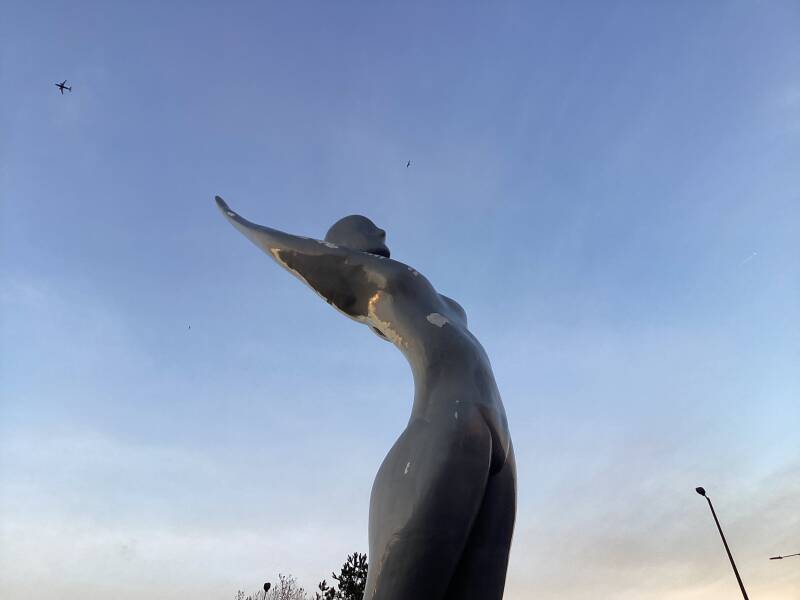
“ATHENA”. Largest artwork ?


Back to the original route along the Royal Albert Dock
A ventilation shaft?
CONNAUGHT TUNNEL!
The construction of CROSSRAIL (now the ELIZABETH LINE) revealed the top of a Victorian railway tunnel for the first time in nearly 80 years.
This is the Connaught tunnel that was constructed in 1878 to run underneath two major docks — has been repaired and upgraded to carry the new trains. In fact, it is the only vintage tunnel to be reused along the entire length of the new line.
The two docks that the railway runs under are linked by a short canal – and it is here that the complex work had to be carried out, as they had found that the roof of the tunnel here was perilously thin. Thus the canal was be drained and the top of the tunnel cut away once again and a new concrete roof put in its place.
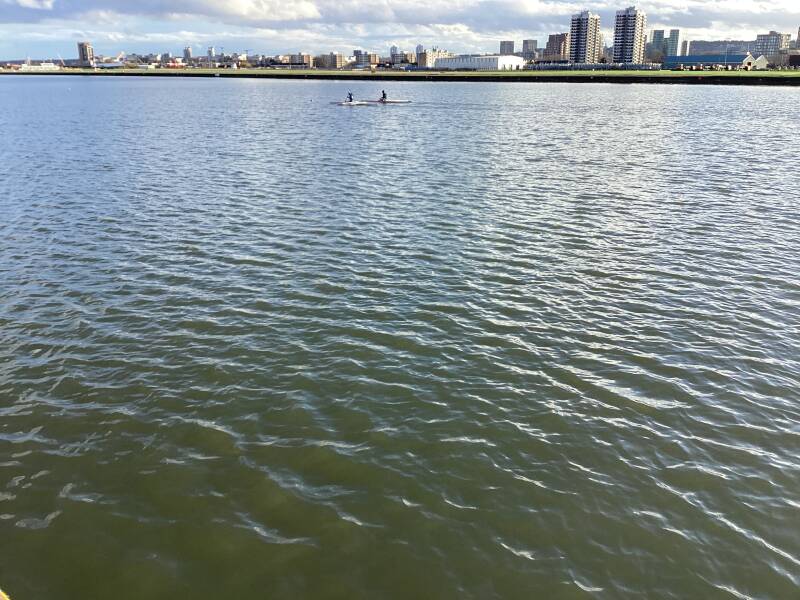
London Regatta Centre
The centre is home to many dragon boat clubs and is ideal for any sized event from 14 to 1000+.
RRDD Watersports Centre
Café & Chinese restaurant
Hotels
Atlantic Pacific
AP delivers training, rescue programmes and outreach that equip young people, volunteers and professionals with the skills to save lives at sea.
2023, Atlantic Pacific opened an office and training hub at the Royal Docks in East London, where we are also an accredited RYA Training Centre.

Possible Diversion: see route Northwards to GREEN STREET for West Ham/East Ham. Alongside BECKTON DISTRICT PARK
Bus STOPS NE of the DLR Station: STANSFELD and STRAIT ROADS
Royal Albert DLR Station

London City Airport
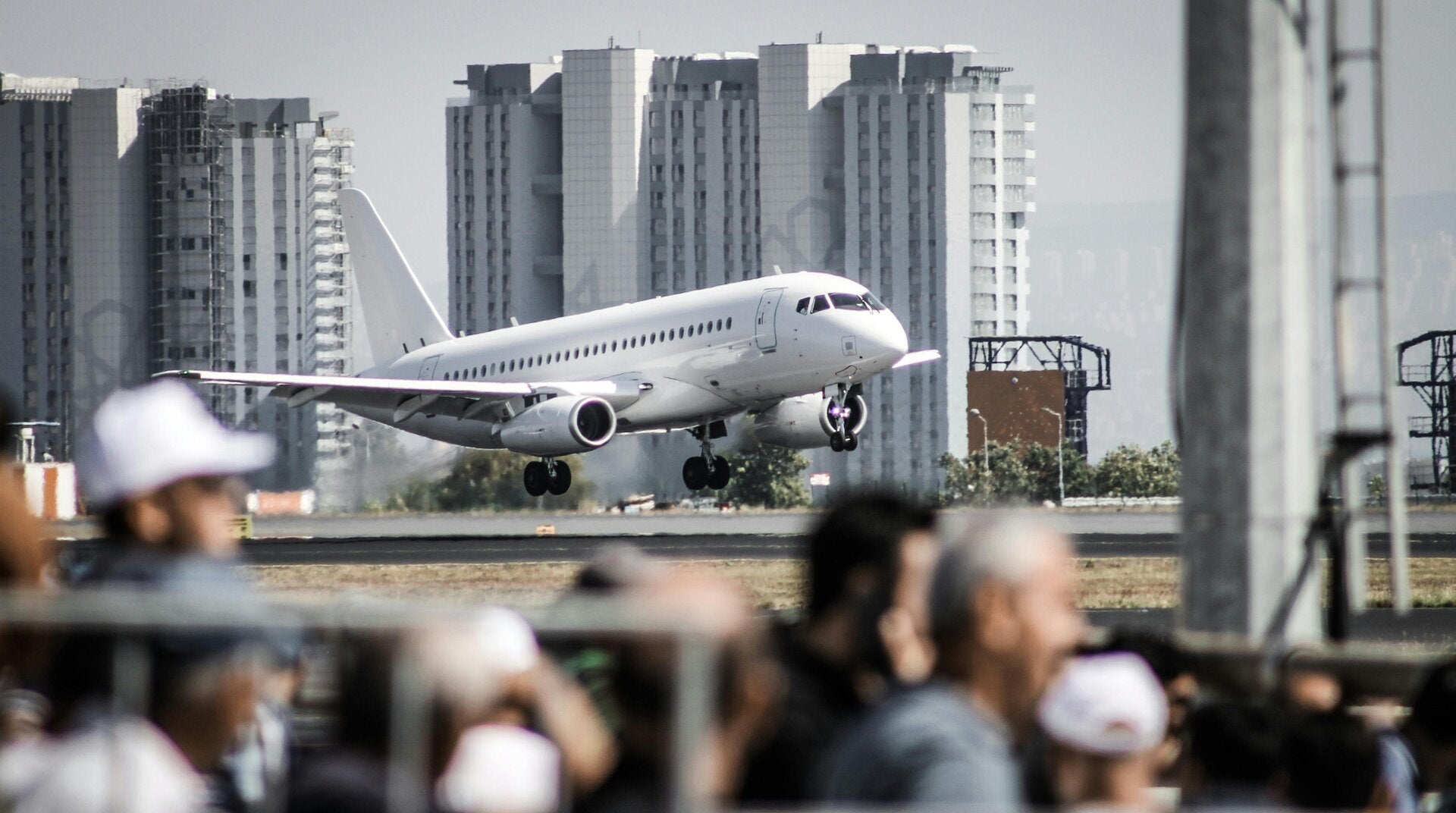
The idea for an airport in the docklands came from the London Docklands Development Corporation in the early 1980s. The concept was for an airport that would service the business centres of the City of London, and the proposed development centered on Canary Wharf in the Isle of Dogs.
The airport would offer swift access from these centres of business, with minimal waiting time at the airport. Almost a “turn up and fly” approach, rather than the longer travel out to airports such as Heathrow and Gatwick, with the lengthier times for check-in, security etc. as well as often delayed take-offs and landings.
The airport was built by the civil engineering and construction company, Mowlem, between 1986 and 1987.
In 1988, its first full year of operation, the airport handled 133,000 passengers. Its record is 5.1 million passengers in pre-pandemic 2019. Because it is so popular, the Government has approved increasing its annual passenger cap from 6.5 million passengers to nine million by 2031.
Many people think LCY is predominantly a business travellers’ airport. Especially as it is just six miles east of the City of London and three miles east of Canary Wharf, the two centres of London’s financial industry. However, in the past decade, the proportion of leisure travellers passing through London City has grown from 20% to 50%. Popular leisure destinations the airport serves include Mallorca and Malaga.
The airport is known for its extremely steep 5.5° approach angle, which is twice the standard angle at most airports. This requires specific aircraft certification for steep approaches, limiting the types of planes that can use the airport. Due to its size and layout, the airport has limitations on the types of aircraft that can use it, with a specific focus on smaller, business-oriented jets
RUNWAY’s unique construction: The airport is built on reclaimed land in the King George V Dock. The runway was constructed on a concrete raft supported by over 3,000 steel piles driven into the dock bed.
REMOTE ATC (air traffic control): London City is the first major airport in the world to be fully controlled by a remote digital air traffic control (ATC) tower, a technology that allows controllers to monitor and manage the airspace from a control center miles away. Control room is at the NATS air traffic control centre in Swanwick, Hampshire. Fourteen high-definition cameras and sensors mounted on a mast at the airport provide a live 360-degree view, which is transmitted via fibre connections to the Swanwick control room where air traffic controllers manage the airport's operations.
ADVANCED SECURITY: The airport was the first in the UK to deploy full CT (computed tomography) security scanners for all passengers. This allows travelers to leave laptops and liquids in their bags, as long as they are in containers up to 2 liters.
POLICE: The airport has its own dedicated 24/7 aviation police force
Unbelievable but true!
It was a Brymon Airways flight what helped prove that planes could take off and land from short landing strips in the docklands. On 27 June 1982 Brymon's Captain Harry Gee landed a de Havilland Canada Dash 7turboprop aircraft on Heron Quays, in the nearby West India Docks, in order to demonstrate the feasibility of the STOLport project.
COMPRESSOR HOUSE
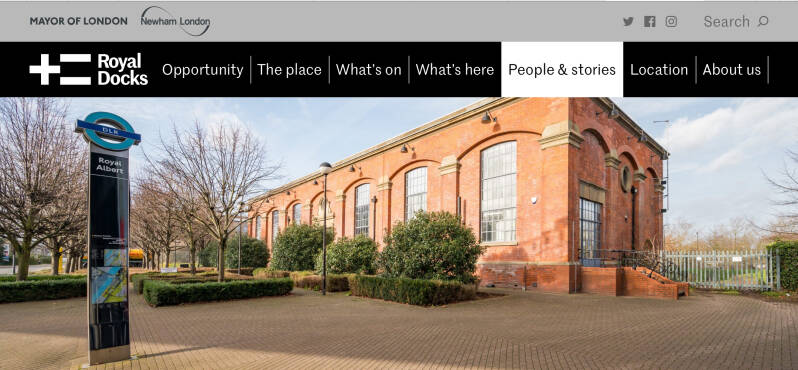
it was built in 1914 as a cold storage facility for cargo. This historic, locally listed building is one of the few remaining structures from the Royal Docks’ time as a global shipping hub. It features distinctive red brickwork and an impressive open hall, where the original hoists, rails, and winching machinery used to move produce have been preserved. Its bold industrial interior and rich heritage
LONDON BOROUGH OF NEWHAM HQ. (Main Offices)
- The modern, glass-fronted building opened in 2010 and serves as the main offices for the council. It features meeting rooms, a cafe
- History: The council consolidated most of its offices here in 2010
Newham London Borough Council/ˈnjuːəm/ ⓘ also known as Newham Council, is the local authority for the London Borough of Newham in Greater London, England. The council has been under Labourmajority control since 1971. It has been led by a directly elected mayor since 2002. The council meets at both Newham Town Hall in East Hamand at the Old Town Hall, Stratford,
The council's full legal name is "The Mayor and Burgesses of the London Borough of Newham", but it styles itself Newham Council
The London Borough of Newham and its council were created under the London Government Act 1963, with the first election held in 1964.[6] For its first year the council acted as a shadow authority alongside the area's outgoing authorities, principally being the two councils of the county boroughs of East Ham and West Ham, but also the borough councils of Woolwich (in respect of the North Woolwich area) and Barking (in respect of the Gallions Reach area) The new council formally came into its powers on 1 April 1965, at which point the old boroughs and their councils were abolished.
From 1965 until 1986 the council was a lower-tier authority, with upper-tier functions provided by the Greater London Council. The split of powers and functions meant that the Greater London Council was responsible for "wide area" services such as fire, ambulance, flood prevention, and refuse disposal; with the boroughs (including Newham) responsible for "personal" services such as social care, libraries, cemeteries and refuse collection. As an outer London borough council Newham has been a local education authority since 1965. The Greater London Council was abolished in 1986 and its functions passed to the London Boroughs, with some services provided through joint committees.[9]
Since 2000 the Greater London Authority has taken some responsibility for highways and planning control from the council, but within the English local government system the council remains a "most purpose" authority in terms of the available range of powers and functions
The London Borough of NEWHAM
London Ambulance Service
A failed project… the ASIAN/CHINESE BUSINESS GATEWAY
A business district thought as a platform for Chinese/Asian companies (finances, high tech, knowledge driven) looking for a base to further business in Europe.
Approved by Mayor Boris Johnson in 2013.
Expected contribution to the economy: £6 billion.
Jobs to be created: 20.000.
Masterplan: TERRY FARRELL and PARTNERS
By: main contractor CITIC CONSTRUCTION and principal subcontractor MULTIPLEX.
Developer: APB (ADVANCED BUSINESS PARKS). Their first BP outside China.
Construction began in 2017 of offices, residential units and retail spaces. Membership clubs… Public realm
Street names: LASCARS, MANDARINS, SINGLOS
Freight Café
BECKTON PARK DLR Station

BECKTON DISTRICT PARK is around the corner. See route towards Green St.
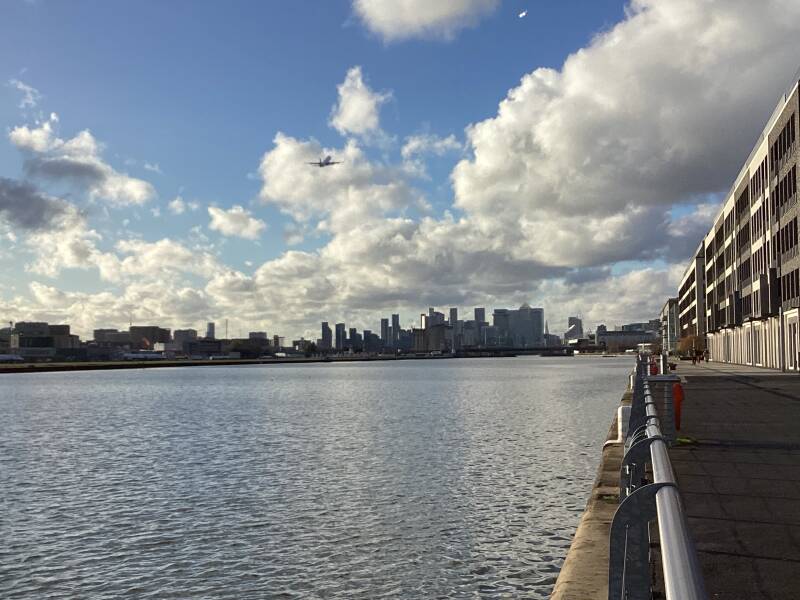
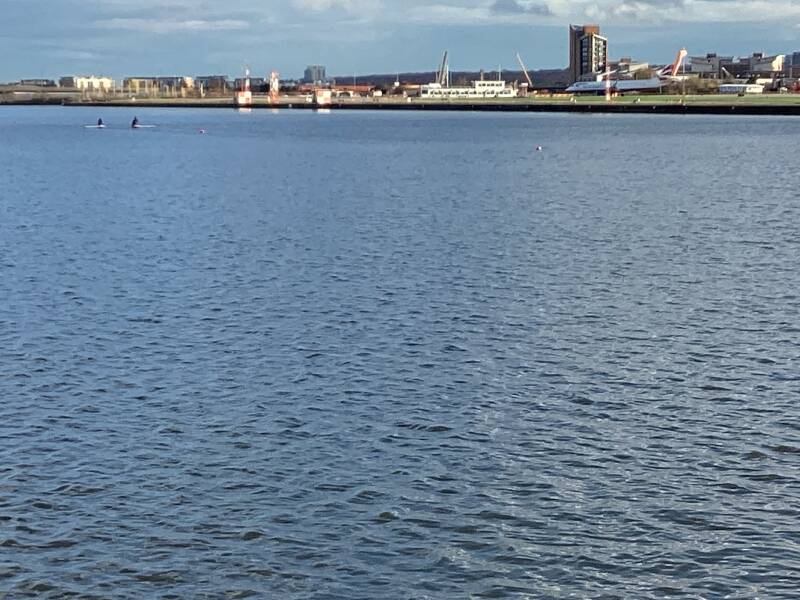
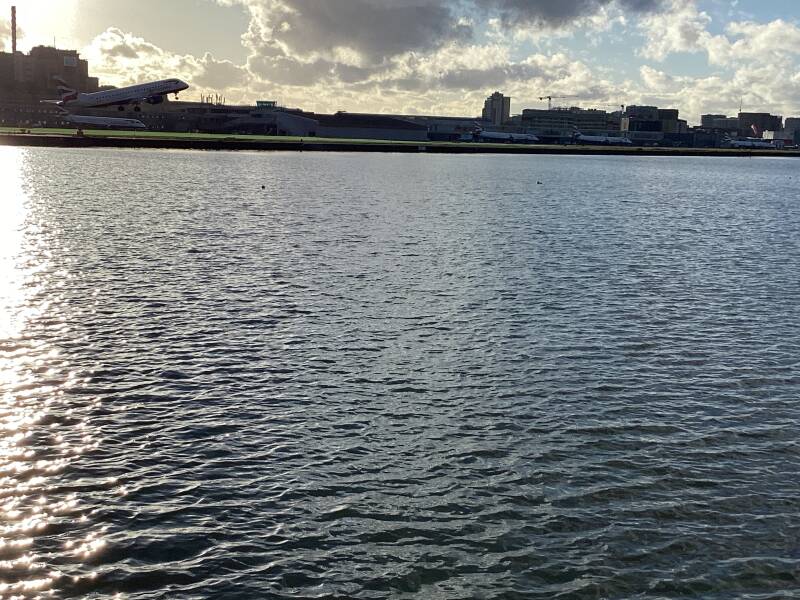
Spot the plane

Former DOCK MANAGER’s and CUSTOMS OFFICE. Intended future use as a club and art gallery
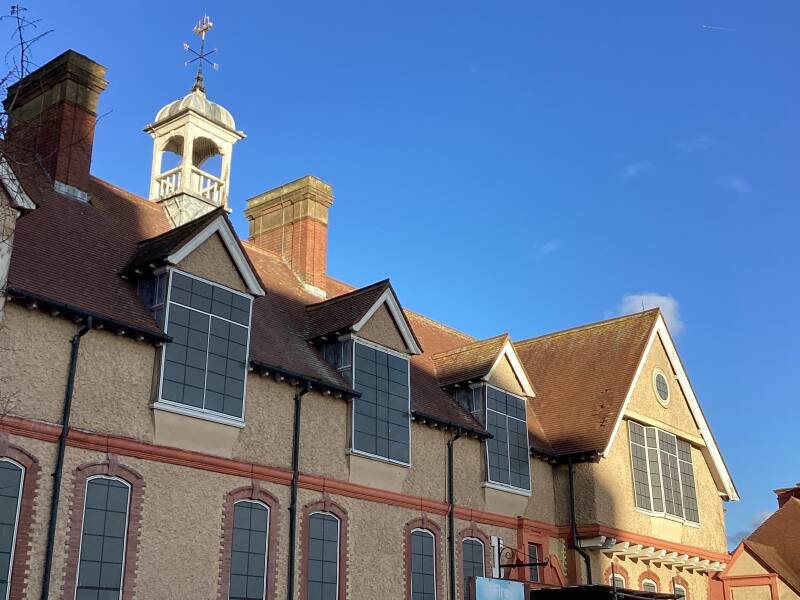
1883. By arch. VIGERS and WAGSFAFFE. In the manner of RICHARD NORMAN SHAW.
Former CENTRAL BUFFET building
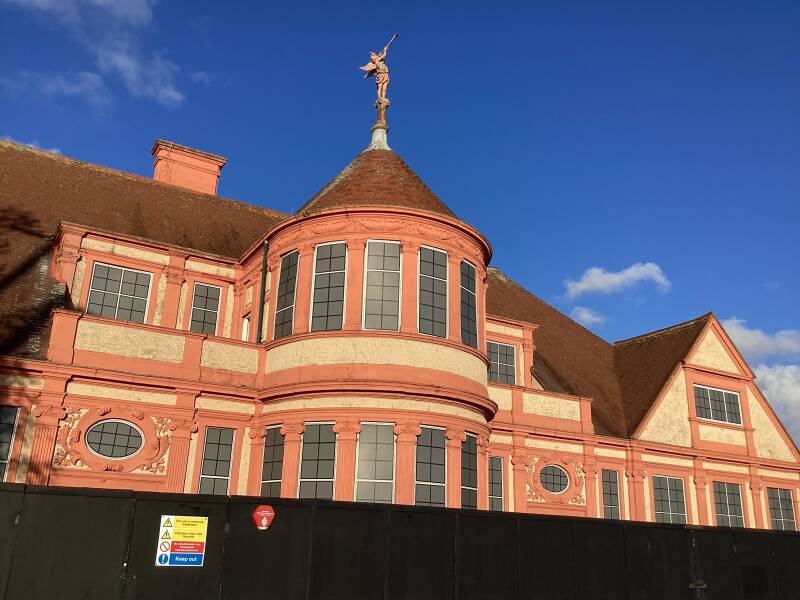
Customs Workers restaurant. 1883. By arch. VIGERS and WAGSFAFFE, in a free Classical style.
Rendered, whitewashed brick, with elaborate dressings. Plain tile roof with moulded stacks.
Two storey bay with curving roof with finial .
Facing gable on either end.
Ionic pilasters.
Oval windows with cartouches.
Three light mullioned windows to gables.
HERALD ANGEL
From A LONDON INHERITANCE (a superb post): “The Central Buffest appears to have been a café / restaurant for workers and for passengers traveling via the Royal Docks. It also appears to have been used as a pub, as this report from the 6th of December 1897 explains;
“BETTING AT THE ROYAL ALBERT DOCKS – At Stratford Police court on Saturday, Thomas Clarey, a lighterman, of 49, freemasons-road, Custom-house, was summoned on six information’s for using the Central Buffet, a public-house in the Royal Albert Docks, for the purpose of betting with other persons, and Henry James Morgan, the secretary of the London and India Docks Joint Committee, the holder of the licence of the Central Buffest, was summoned for permitting the place to be used for the purposes of betting.”
A “barmaid” was also called to give evidence, so the Central Buffet was certainly also working as a pub.
The Dock Managers Office and the Central Buffet are remarkable buildings, and from their appearance they would be more expected in the suburbs, or as a country house, rather than in the industrial east London docks.
Winged figure with trumpet on top of the Central Buffet:
LONDON DESIGN and ENGINEERING UTC

University Technical Colleges (UTCs) are government-funded schools that offer 14-19 year olds a great deal more than traditional schools. They teach learners technical and scientific subjects in a whole new way and are educating the inventors, engineers, scientists and technicians of tomorrow.
CYPRUS DLR Station
An unusual design for a stationAs the DLR runs in the median of a major road, the station is located at the intersection (in the centre of the roundabout). While the road rises, the railway track dips
CYPRUS?
The estate was built around 1878 and named in commemoration of the acquisition of the island by the UK
UNIVERSITY OF EAST LONDON CAMPUS
public universitylocated in the London Borough of Newham, London, England, based at three campuses in Stratford and Docklands, following the opening of University Square Stratford in September 2013.[2]The University of East London began as the West Ham Technical Institute and it was officially opened in October 1898 after approval was given for the construction of the site by the West Ham Technical Instruction Act Committee in 1892 following the Technical Instruction Act of 1889. It gained university status in 1992. It was formerly known as College of East London.
The community is made up of over 40,000 students from over 160 countries
The campus was shortlisted for the Royal Institution of Chartered Surveyors' Building of the Year in 2001
PETCHEY CENTRE FOR ENTREPRENEURSHIP. Business school
The "Petchey Centre for Entrepreneurship" is an initiative that supports aspiring entrepreneurs, particularly in East London. It was incorporated into the University of East London's (UEL) Business School and named in honor of benefactor Jack Petchey, an entrepreneur who founded the Jack Petchey Foundation. The center aims to stimulate entrepreneurial development and provides support such as expert advice, mentorship, and workspace.
HALLS OF RESIDENCE
New student accommodation opened in 2008 and the campus now has 1,200 student rooms, together with shops, cafés and a restaurant, launderettes and an open-air fitness suite. SportsDock, a £21 million sports and academic centre, opened in March 2012.[19] SportsDock served as the High-Performance Training Centre for Team USA during the London 2012 Olympic Games.[20]
The campus library is housed in the Royal Docks Business School building.
Beautiful sunset views, on Google maps!

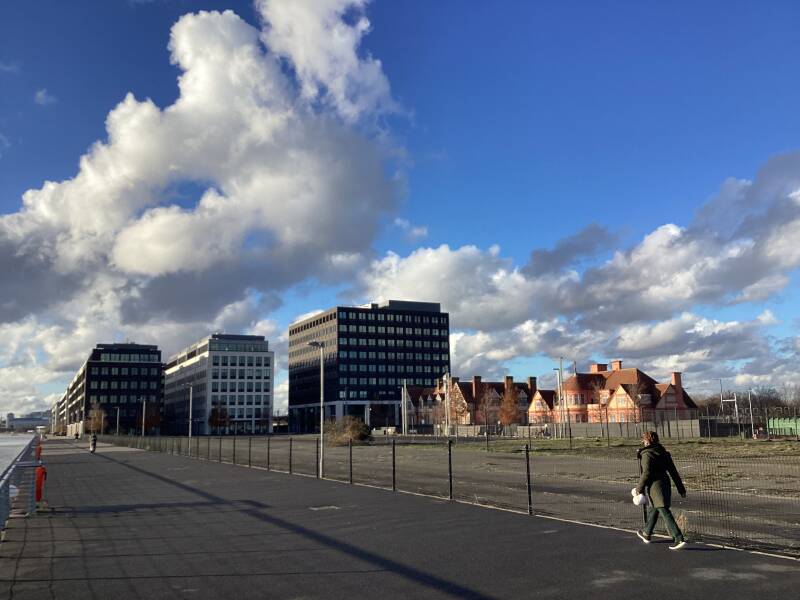
Shortcut with marvellous views of airplanes takeoffs and landings
Woolwich Manor Way-SIR STEVE REDGRAVE BRIDGE
Airport Cut Berth
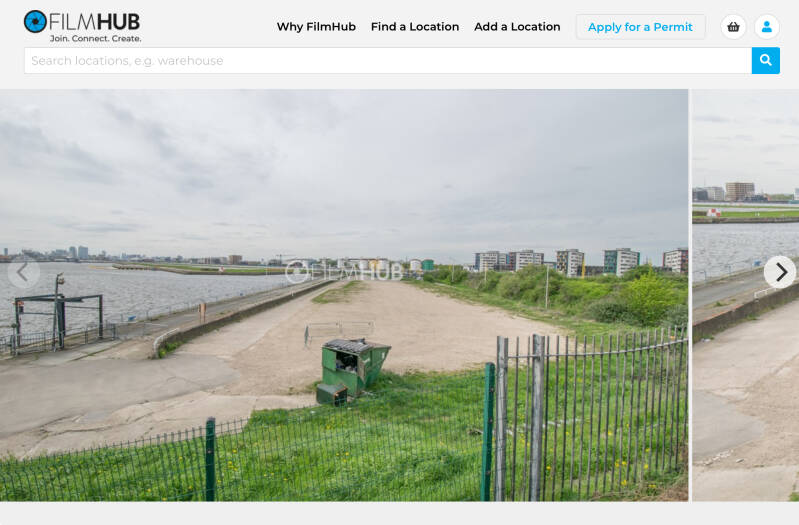
Cut Berth?: This describes a specific type of dock where a vessel can enter but has no way to turn around, forcing it to back out. The term is often used in a nautical context and is also used as a film location term.
BUS routes SL2 and 474 stops. Both sides along the bridge
Former GALLIONS HOTEL, now GALYONS restaurant
3 Storeys building overlooking GALLIONS REACH. B. c 1835, as a hotel On timber piles, with stables underneath.Passengers and crew of P&O ships could make their way to the ship berthed on the dock alongside a tunnel.
Shops of up to 12.000 tonnes used to berth here.
The GREAT EASTERN RAILWAY used to run a service from FERNCHURCH STREET STA. Trains as well from LIVERPOOL ST.STA.
The current building was erected by the ST.KATHARINE’S DOCK COMPANY in the 1880s. VIGERS and WAGSTAFFE, architects and surveyors.
Tall chimneys with handcut mouldings. Dormers and gables from overhanging top floor.
In the 1930s it was run by TRUMAN, HANBURY AND BUXTON BREWERY. With a solid Victorian interior, with a lot of mahogany in its fittings. ALBERT GRAVELEY LINNEY.
Ringed by a frieze of busty plaster nymphs, by artist EDWIN ROSCOE MULLINS.
Decline of shipping, BLITZ, closure 72.Restored by the LDDC in the 1990s.
You might assume the name has something to do with ships, but it actually comes from the Galyons, a family who owned property around here from the 14th century.


To the N of the quayside, close to GALLIONS ROUNDABOUT
GALLIONS REACH DLR station
Convenience and eateries

A Route to Beckton and on to Barking, starts at the roundabout…
Pumping station
On the roundabout where Albert Way meets Woolwich Manor Way and Royal Docks Road. This was originally constructed to pump water away from the Beckton marshes to allow for development.
Back in the Albert Dock
PUMPING STATION
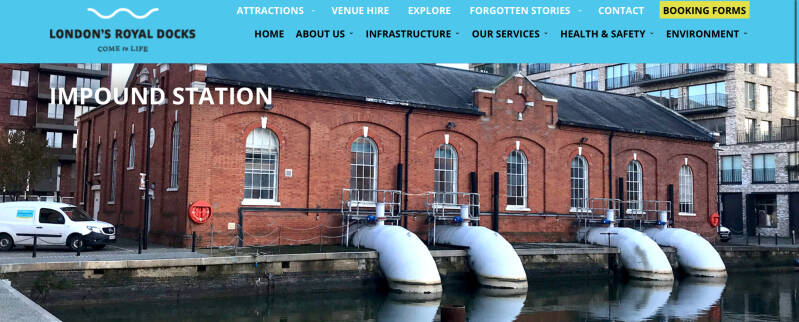
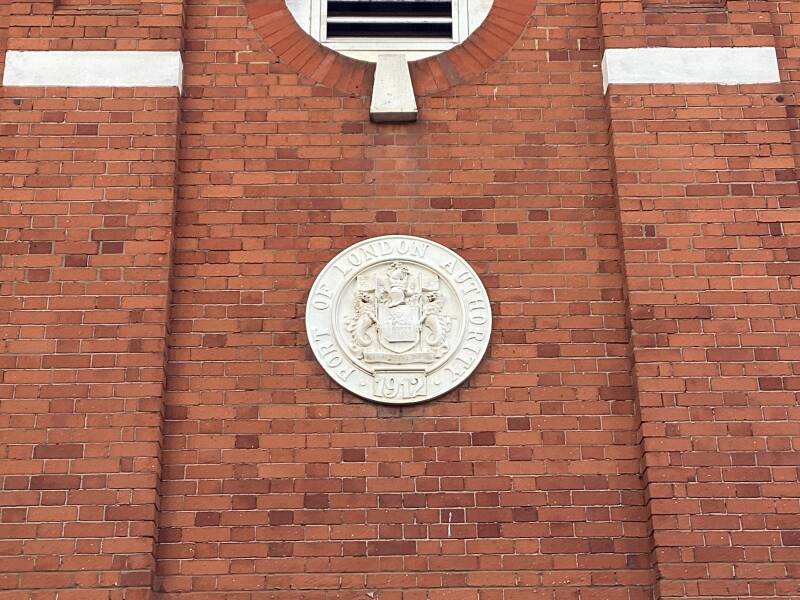
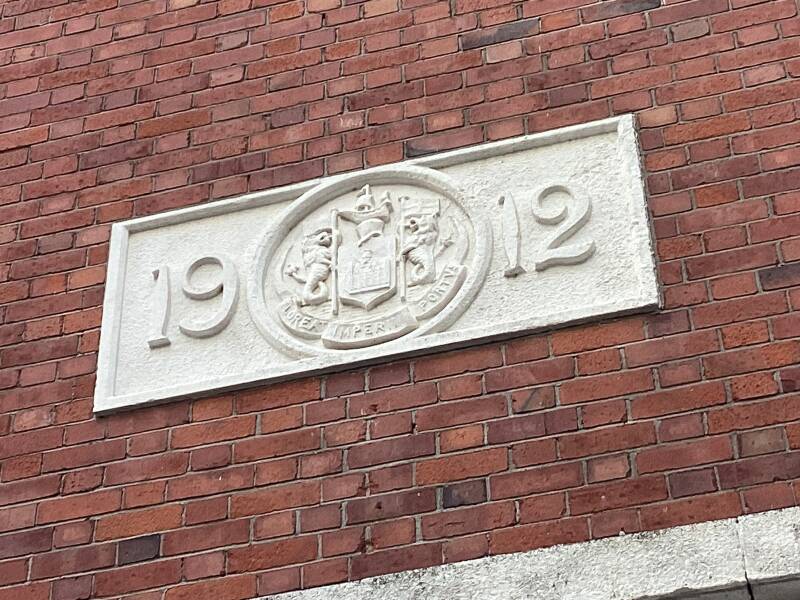
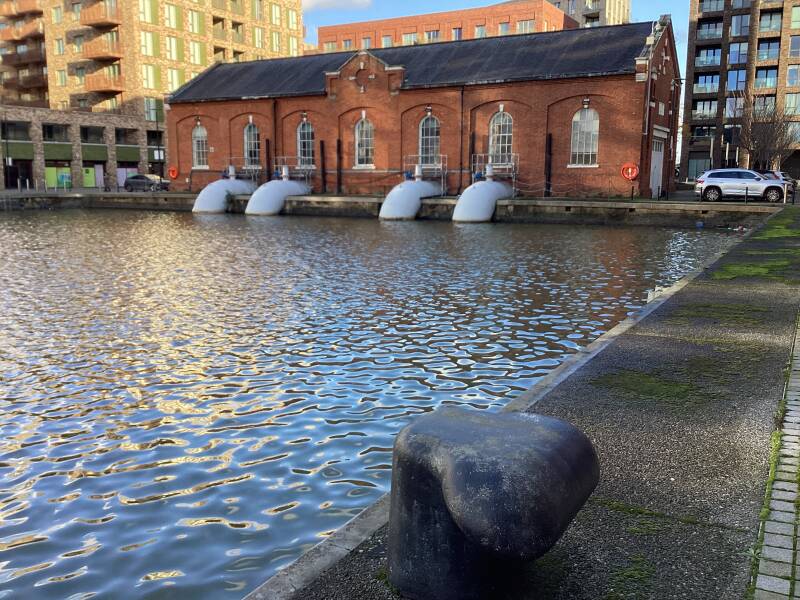
The Impound Station is a key infrastructure facility serving to pump water from the River Thames for two reasons:
To maintain the water level within the docks between its upper and lower limits. Water is lost within the docks through seepage, evaporation and lock movements.
To allow water level adjustments to be made to enable inspection of the dock walls and the false quays
The station was built in 1912 and originally housed 3 steam driven pumps. Four electrically powered pumps replaced these in 1954. The pumps were changed again in 2003 for the electrically powered pumps we see today.

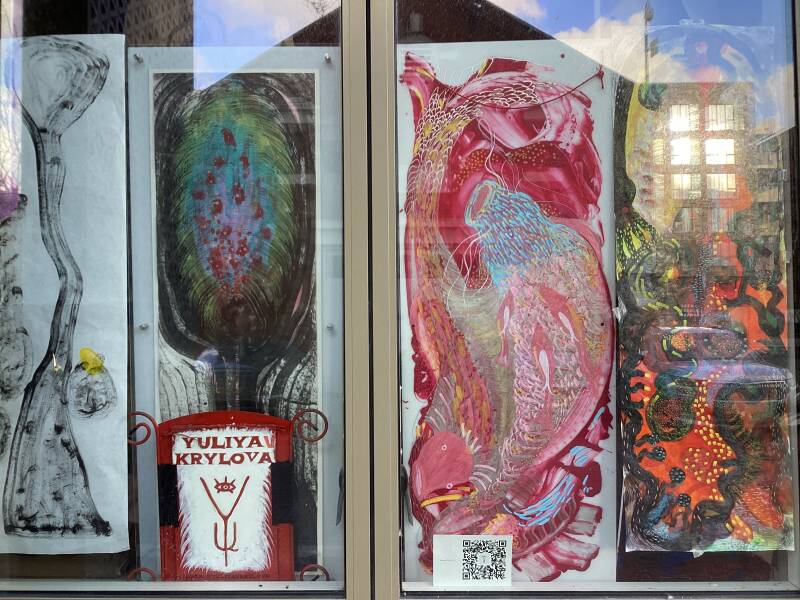
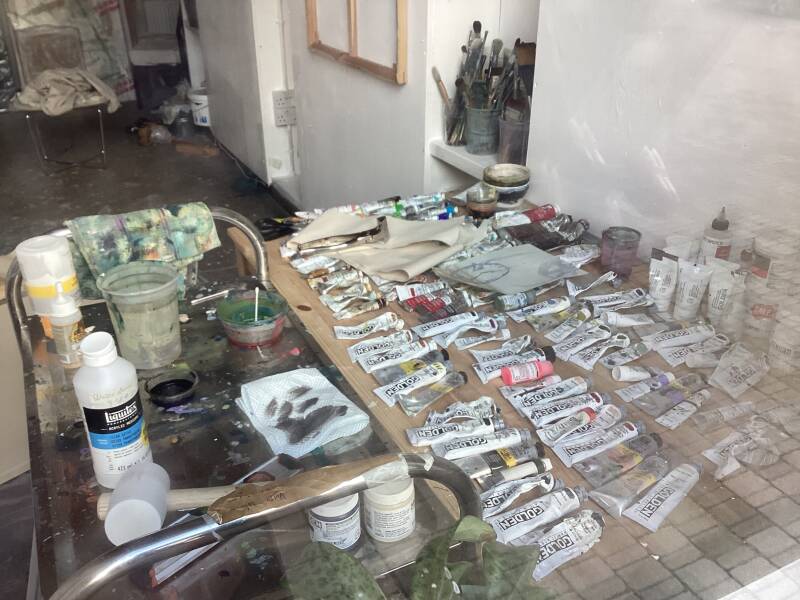
Karl Peter PENKE at work
KING GEORGE V DOCK
Begun in 1912 by the Port of London Authority, the King George V was the last of London's upstream enclosed docks to be built. After delay by the First World War, construction was completed in 1921.[1]Although at 64 acres (26 ha) of water it was smaller than the other royals, it had its own entrance from the Thames through a lock and bascule bridge. The dock could berth liners as large as the RMS Mauretania. At its western end was a large graving dock (since filled in) and machine shop used for ship repairs by Harland & Wolff.
Locks

Gallions Road + river path. You are following the Capital Ring path
Former port buildings
ALBERT ISLAND future development?
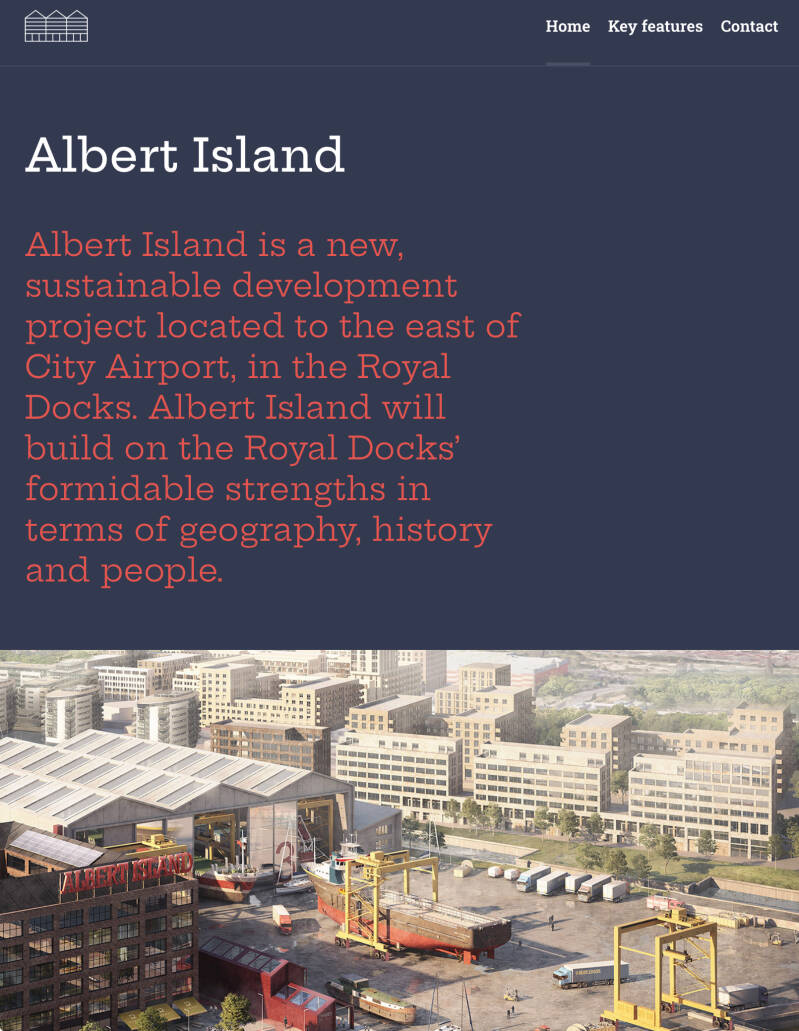
”Albert Island lies directly on the flightpath into City Airport. What's more the end of the runway is only quarter of a mile away at this point so planes swoop low on approach and/or screech off overhead after takeoff. It thus isn't possible to build any kind of highrise building here, nor is the nearby roar of jet engines starting conducive to buying one. The long-term vision for Albert Island has therefore been for something non-residential, with ideas including a "state of the art commercial shipyard", a "River Centre for London", a sustainable employment magnet" and a research-based "Ideas Factory". Now it seems two of the City's centuries-old wholesale food markets will be filling much of the space, again with pretty decent ongoing transport connections, once a proper plan has been shaped and agreed.”
Here you have the whole post: https://diamondgeezer.blogspot.com/2025/12/albert-island.html
ALBERT ISLAND: chosen as future site for London’s Smithfield and Billingsgate markets!
The Royal Docks is owned by the Greater London Authority (GLA), and it has been working with the City of London and Newham Council to explore moving the meat and fish markets to Albert Island.
”New new” BILLINGSGATE and “New” SMITHFIELD?: https://londonist.com/london/news/smithfield-and-billingsgate-market-could-be-saved-with-new-site-in-royal-docks
The Thames here: GALLIONS REACH. Nothing to do with the galleon type of ship…
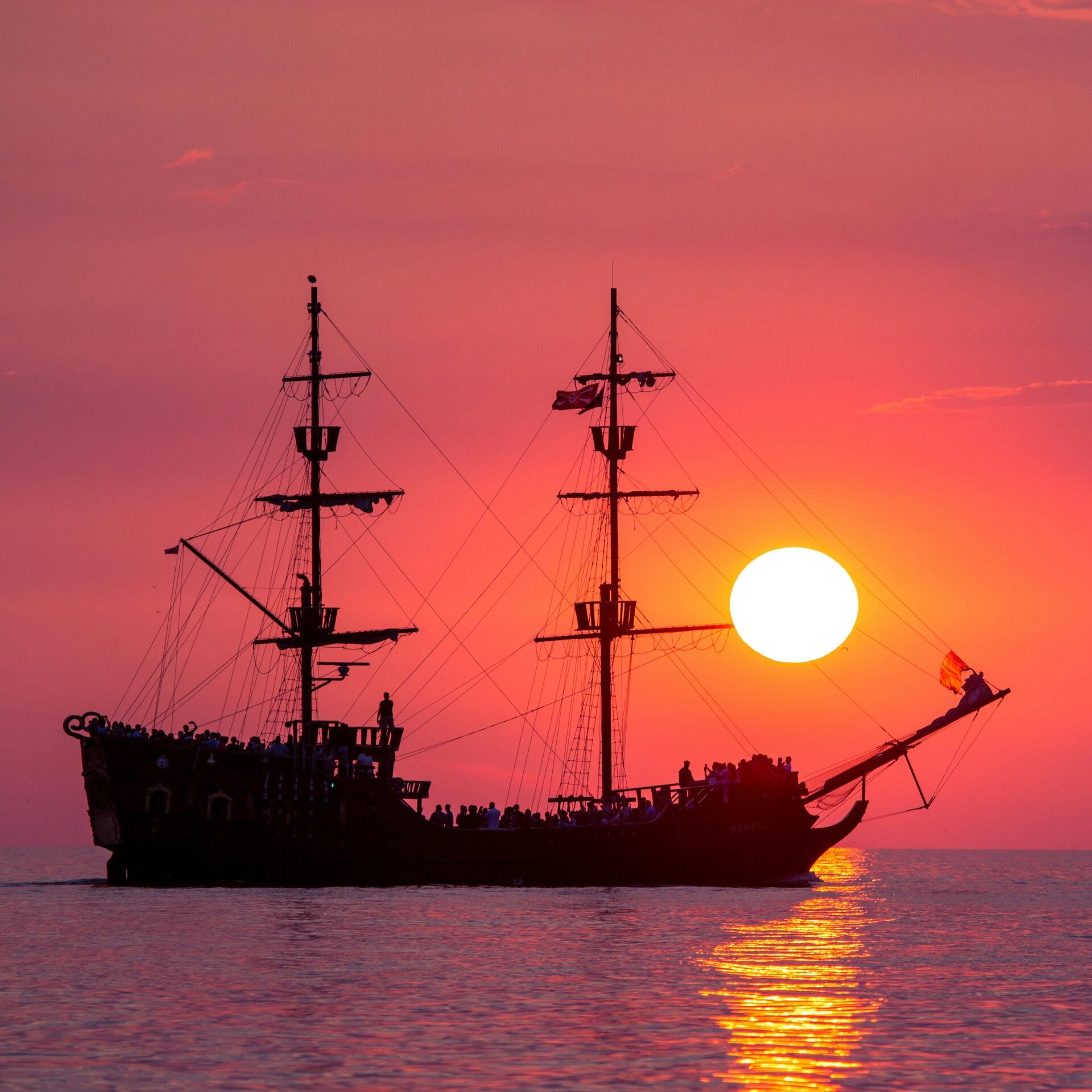
A reach is a segment of a stream, river, or arm of the sea,[citation needed] usually suggesting a straight, level, uninterrupted stretch.[1][2] They are traditionally defined by the capabilities of sailing boats, as a stretch of a watercourse which, because it is straightish, can be sailed in one "reach" (that is, without tacking).
Reaches are often named by those using the river, and a reach may be named for landmarks, natural features, and historical reasons (see, for instance, Gallions Reach, named after the family that once owned its banks).
King George V Dock Lock
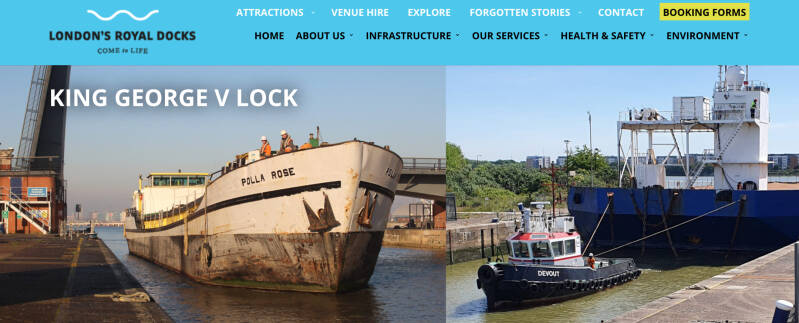
It consists of three sets of mitre gates (16m x 17m each gate) in a lock approximately 243.8m long, 30.48m wide, and a cill depth below chart datum of 6.90m. The lock allows access into the Royal Docks from the River Thames.
Site of HARLAND & WOOLFF, now GALLIONS POINT
former Harland & Wolff North Woolwich shipyard is now a residential area called Galleons Point. The site, which was the largest shipyard in London until it closed in 1972, has been redeveloped for housing as part of a wider urban regeneration project in the Royal Docks area.
Harland & Wolff is best-known as one of Britain’s premier ship-building companies, perhaps most famously building the Titanic at their Belfast yard, with a long history stretching back to the middle of the 19th century.
From the 1920s until the 1970s the company also built smaller vessels, as well as repairing ships, from several sites in London’s docks.
Harland & Wolff is famous for having built the majority of the ocean liners for the White Star Line in the early 20th century, including the Olympic-class trio – RMS Olympic, RMS Titanic and HMHS Britannic.[6] Their notable ships also include the Royal Navy's HMS Belfast; Royal Mail Line's flagship Andes; Shaw, Savill & Albion's Southern Cross; Union-Castle's RMS Pendennis Castle; P&O's Canberra; and Hamburg-America's Amerika of 1905.
In 2022, the company was awarded a major naval contract as part of Team Resolute (alongside Navantia UK and BMT), to deliver the Royal Fleet Auxiliary's three new Fleet Solid Support vessels.
All that remains of Harland & Wolff North Woolwich are the works’ gates. They were saved, as were two other sets of gates from other Harland & Wolff sites. In 1994 the North Woolwich gates were erected in Lyle Park at Silvertown, a short distance from the old works. Lyle Park had opened in the same year as Harland & Wolff North Woolwich
Barge house Road
The road is obviously named after the pub (which stood to the left of the following photo), and the old drawdock, and the barge used at some point as a home by an operator of the ferry:
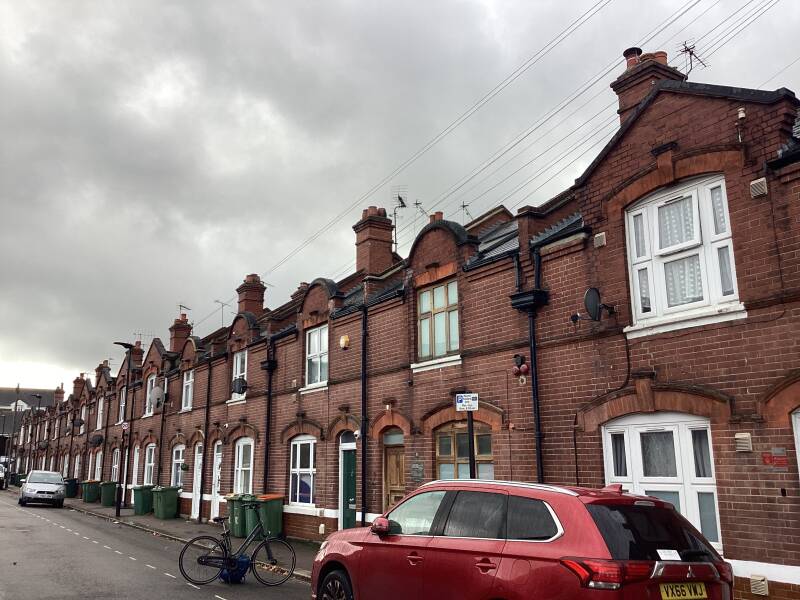
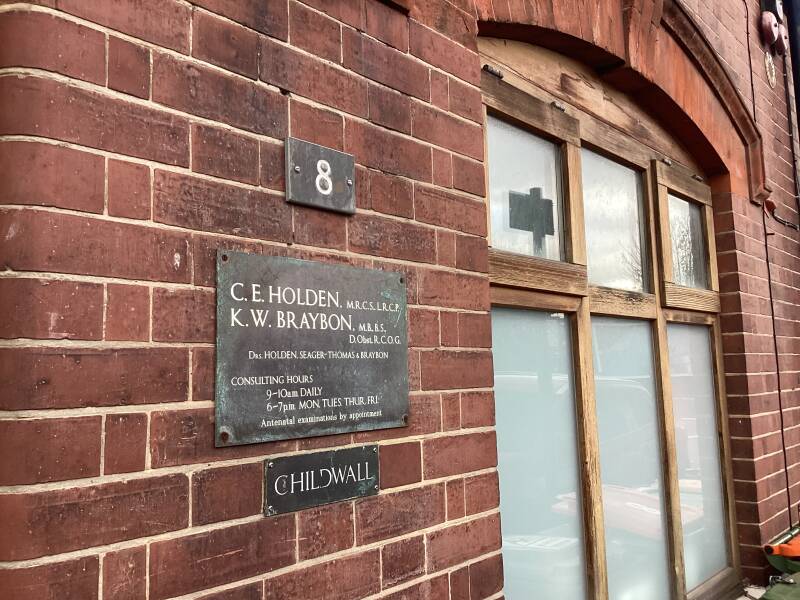
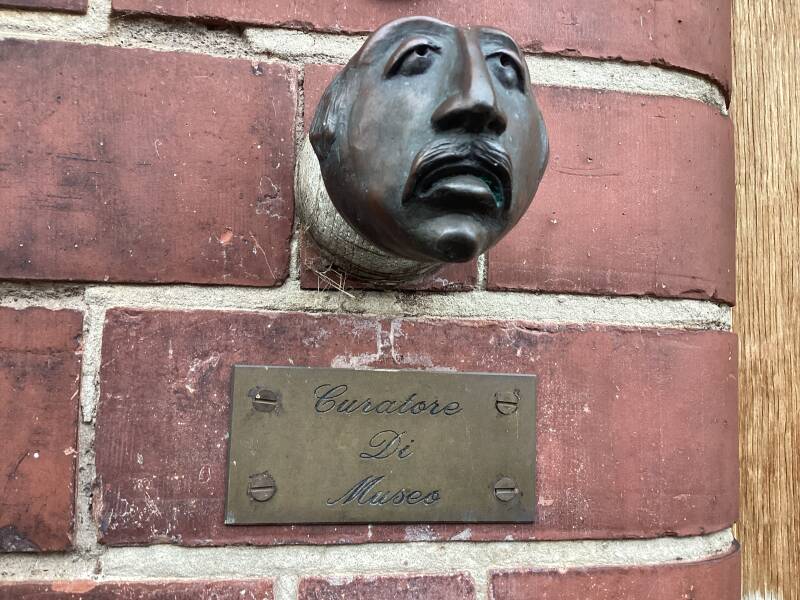
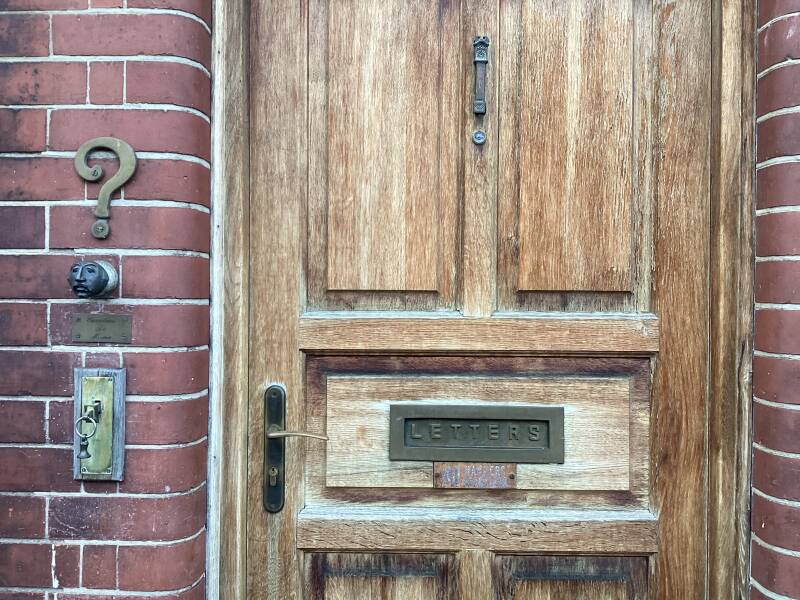
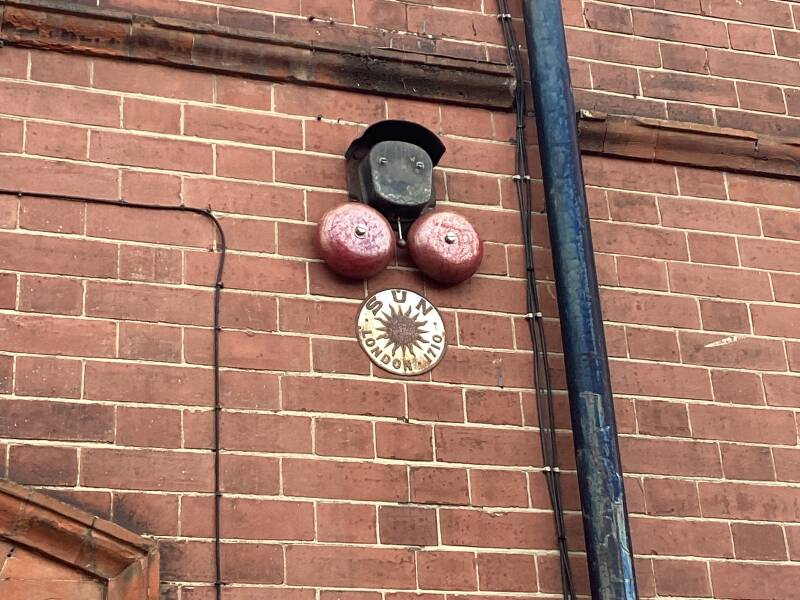
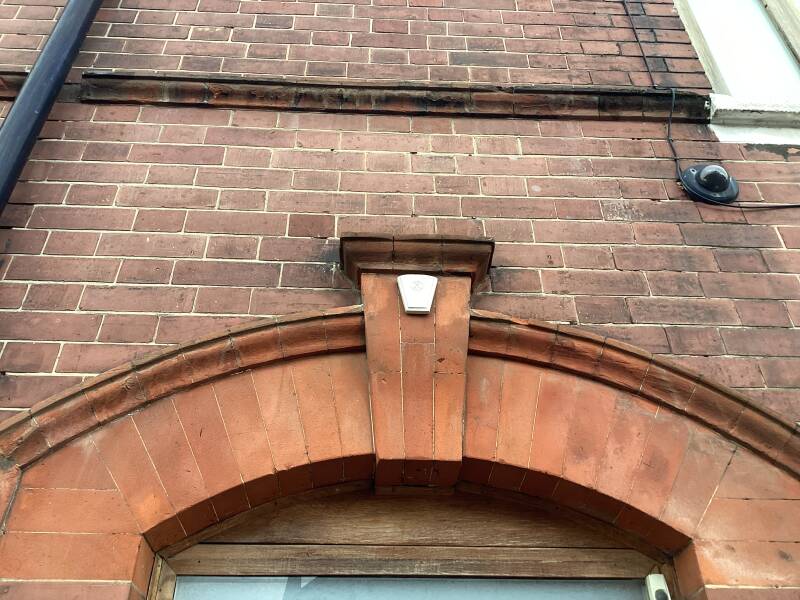
Former DRAWDOCK, site of ancient FERRY
Although it is just Bargehouse Causeway today, the use of the name Old Barge House Drawdock in the PLA listing provides a better indication of its age.
The causeway is the site of one of the first ferries between what is now North Woolwich, and the town of Woolwich, between what was Essex and Kent, and was first mentioned in 1308.
There are very few mentions of the ferry up until the end of the 18th century, and in the following decades the ferry at Old Barge House Drawdock seems to have been a very active place.
It was in use for foot passengers crossing the Thames, as well as farmers taking their produce to market, with a frequent route being Kent farmers taking cattle to market in Romford.
The name of the draw dock seems to have come from the home of one of the early operators of the ferry, who had dragged up an old barge from the river, and lived in the barge above the shoreline.
Former ROYAL PAVILION PLEASURE GARDENS ROYAL VICTORIA GARDENS
The Royal Victoria Gardens occupy much of the space of the old Royal Pavilion Pleasure Gardens.
The Pleasure Gardens continued in use until the late 1880s. They were very popular, and there are newspaper reports of the crowds that would head to the gardens in the summer, however by the end of the 1880s the pleasure gardens were in financial trouble, and the gardens were taken over by the London County Council, and renamed as the Royal Victoria Gardens.
The gardens suffered much bomb damage during the last war, resulting in the loss of many of the original features of the gardens, which included features such as an Italian garden, a maze, flower beds and a rifle range, however the gardens remain a really good area of green space, with the added benefit of being alongside the River Thames.
There is an interesting example of industrial machinery in the Royal Victoria Gardens: This is a steam hammer, dating from 1888, and was from the blacksmith’s shop of R.H. Green and Silley Wier Ltd, at the Royal Albert Docks, on the site of what are today, the buildings of London City Airport. The steam hammer was installed in the gardens in 1994.
Former NORTH WOOLWICH railway station
the eastern terminus of the North London Line. The station closed in 2006, to allow for the North London line between Stratford and Canning Town to be converted to Docklands Light Railway (DLR)operation. At closure the station was served by Silverlink.
The historic station building (built by Sir William Tite in 1847) was Grade II-listed in 1998.
The route became an extension of the North London Line (NLL) in 1979. In 1979, the original station building and a platform were closed, being replaced by a minimalist entrance and passenger shelter on the south side.[5]From the 1980s onward, only one track of the double track line was used through the Connaught Tunnel under the Royal Docks and on to North Woolwich.
In 1985 the line from North Woolwich was electrified on the third rail system under British Rail, with the service running round inner north London to Richmond (a route part-third rail and part-overhead wire).
From 1984 until 2008 the original station buildings and one disused platform served as the North Woolwich Old Station Museum, dedicated to the history of the Great Eastern Railway.[5]The building was then owned by the Passmore Edwards Museum Trust and run by the London Borough of Newham - on its closure most of the collection was dispersed and the building passed to the Trust's successor, the River Lea Tidal Mill Trust.
- The Royal Docks Heritage Railway proposed a new museum at the site with a heritage railway.
-
but high maintenance costs led to it being sold on to a property investment firm, Sav Group, in 2018,[8] with the station building and trackbed subsequently being purchased in 2021 by the New Covenant Church.[9]
In 2023 plans were submitted to redevelop the former goods yard with apartments, a café and a commercial space
North Woolwich Station arrived before the construction of any of the Royal Docks. The line and original wooden station building opened in 1847 by Eastern Counties Railway, who in July 1847, “gave an excursion train on Monday last, from Ely to London, Woolwich, Greenwich and Gravesend, the company being taken by the new line to the North Woolwich Station, where steamers were in readiness to carry them whither their inclination led them. About 250 persons availed them of the trip. The train returned to Cambridge by 9 o’clock.”
I can imagine that if you lived in the Cambridgeshire city of Ely in 1847, London, as well as places such as Woolwich, Greenwich and Gravesend, along with all the river traffic and trade, would have been perhaps a once in a lifetime trip, certainly a trip to some of the rarely visited parts of a dynamic part of London (or Kent as it was then, however many newspaper reports referred to North Woolwich as being in Essex).

Albert Road, for CITY AIRPORT and CONNAUGHT BRIDGE
Former Pier
When the station opened in 1847, there was nothing much on the north side of the river that needed a railway, but it was built to serve the town of Woolwich across the river, and the station did soon lead to developments on the north bank.
So that those living or working in Woolwich could reach the station, a ferry was needed, and two piers were built, one on the south and one on the north banks of the river. The pier on the southern side has long gone, but the north pier remains:
Foot tunnel N entrance
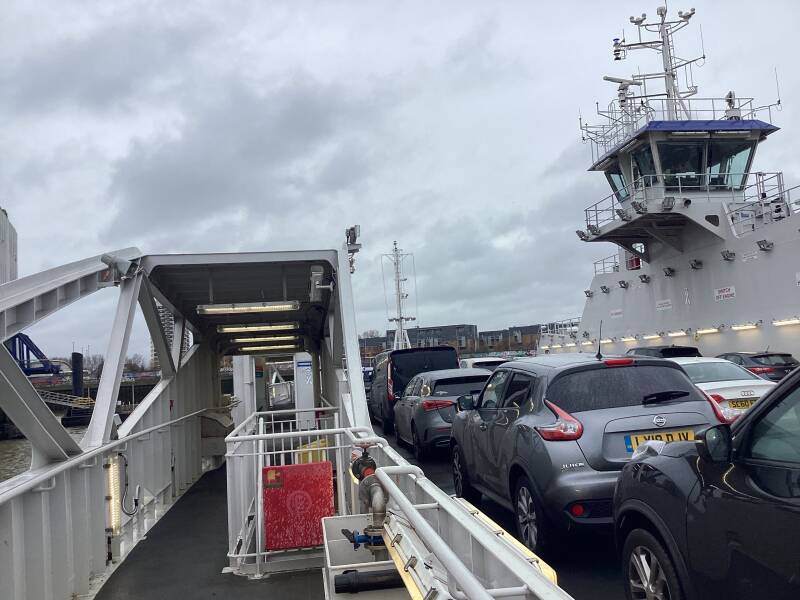
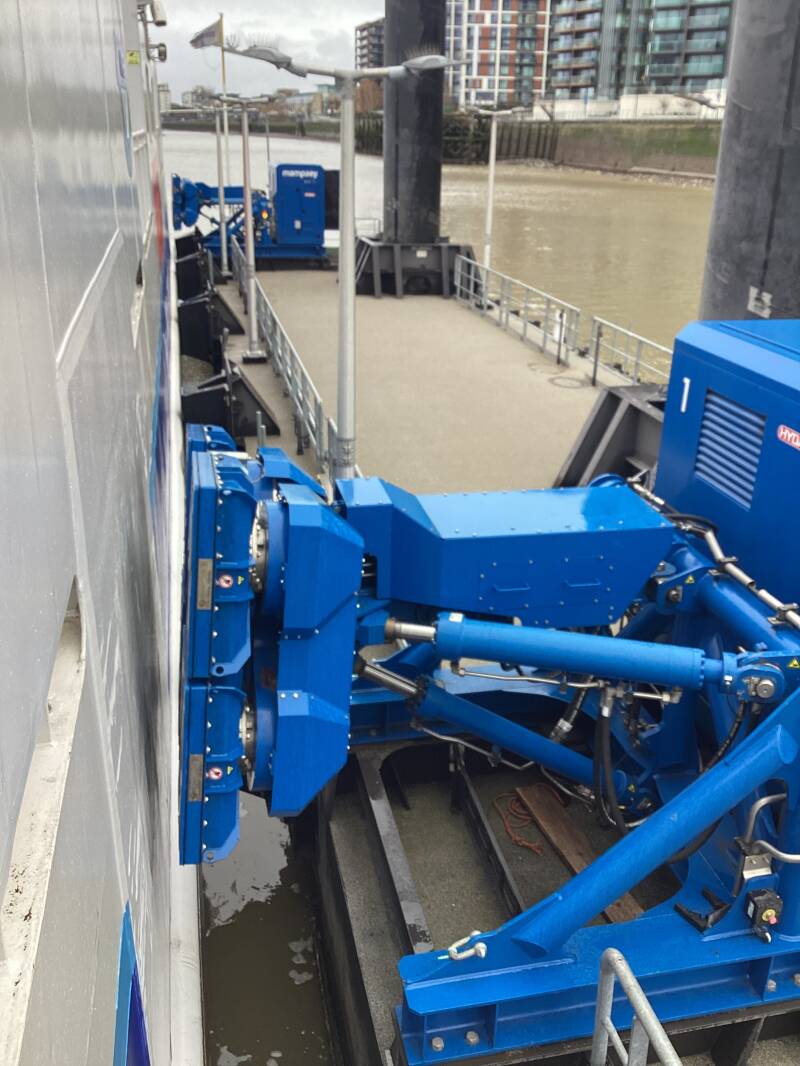
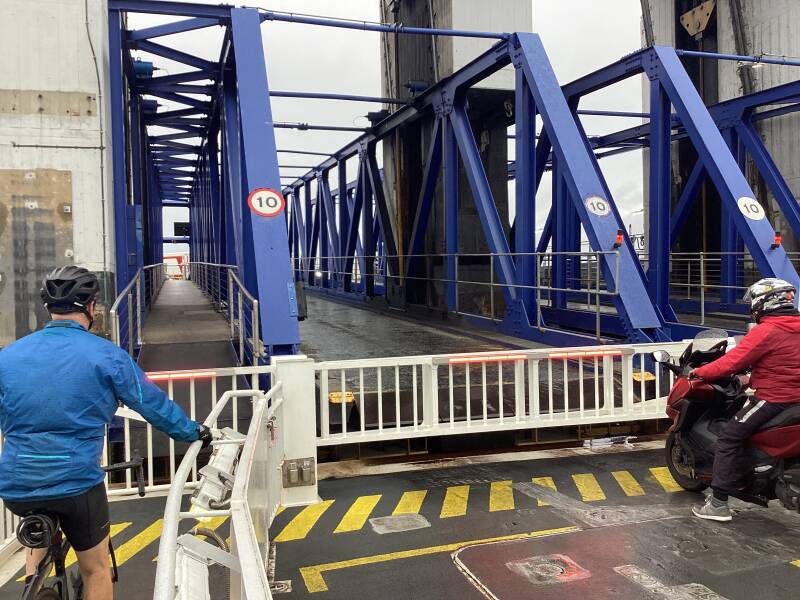
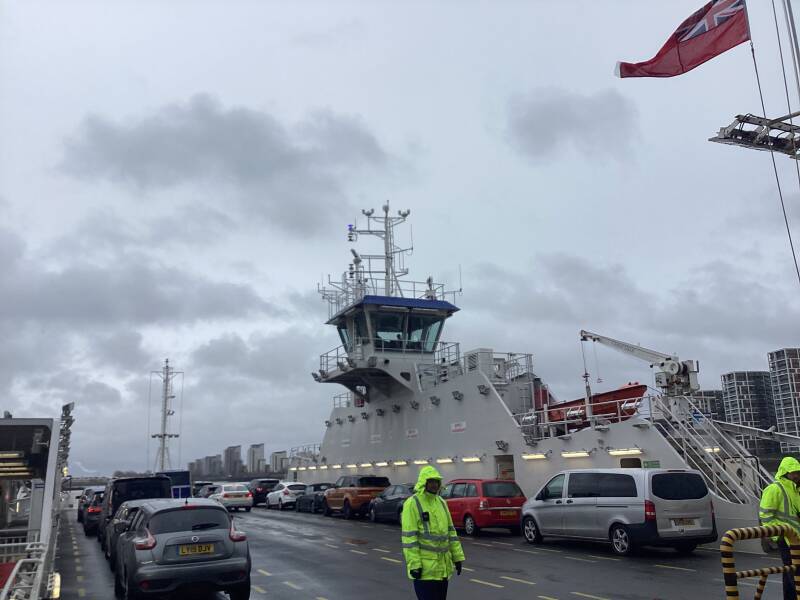
WOOLWICH FREE FERRY

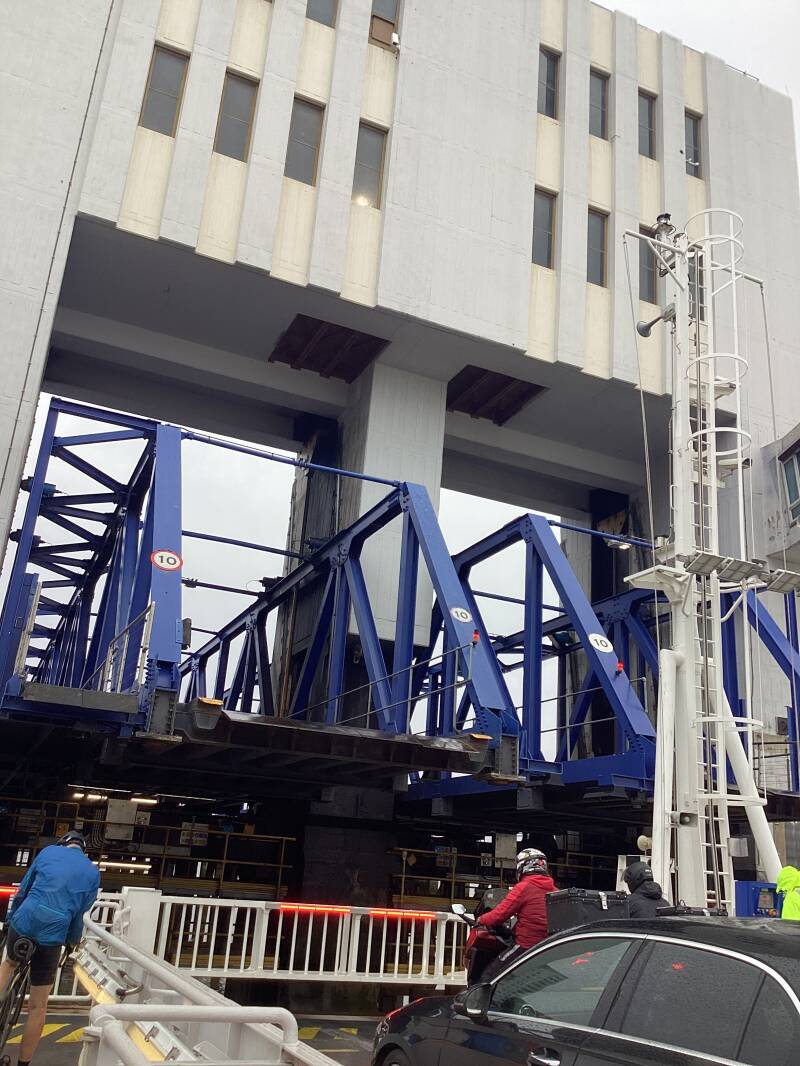
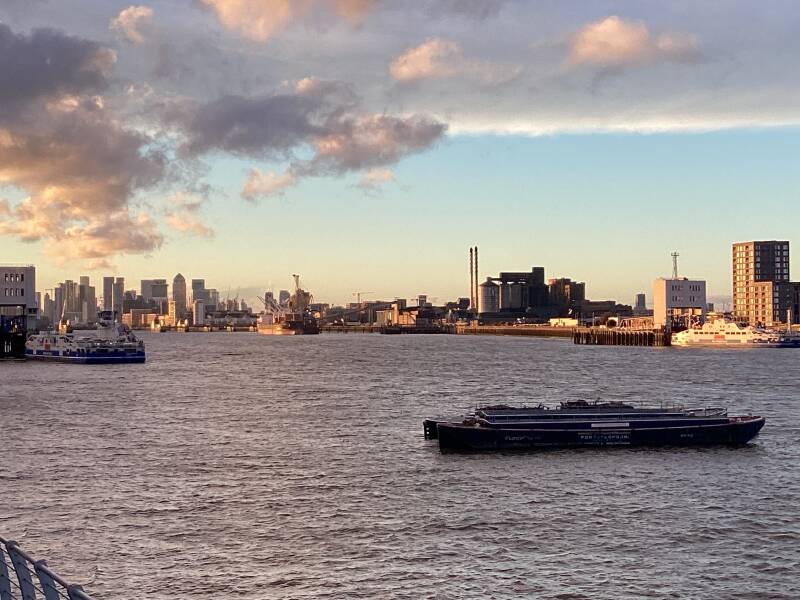
The Thames here: WOOLWICH REACH

I hope you are enjoying this guide!