
From
ROYAL ALBERT DLR STATION to PLAISTOW, WEST HAM PARK and FOREST GATE


FROM ALBERT DOCK same route as previous chapter until LONSDALE ROAD
Alongside BECKTON DISTRICT PARK, crossing NEWHAM WAY (motorway) and GREEWAY (cycle/walking path)
Continue on NEW CITY RD.
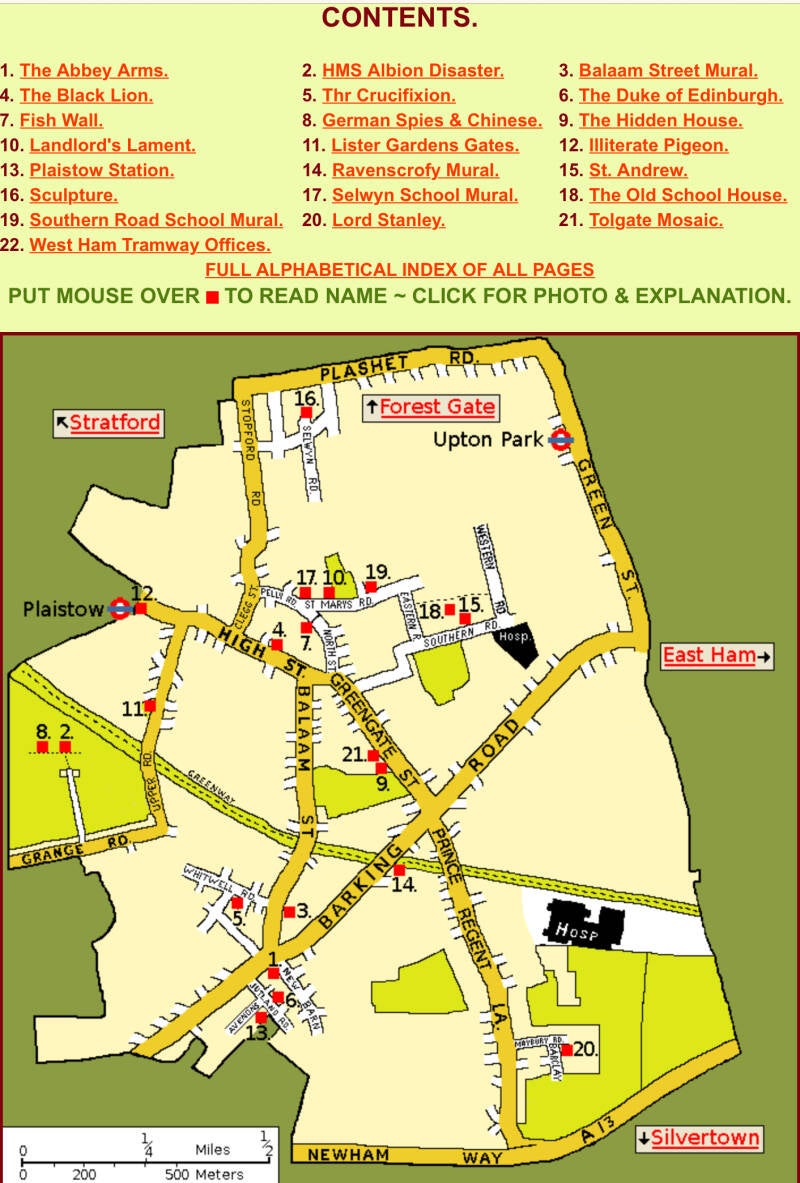
New City Road
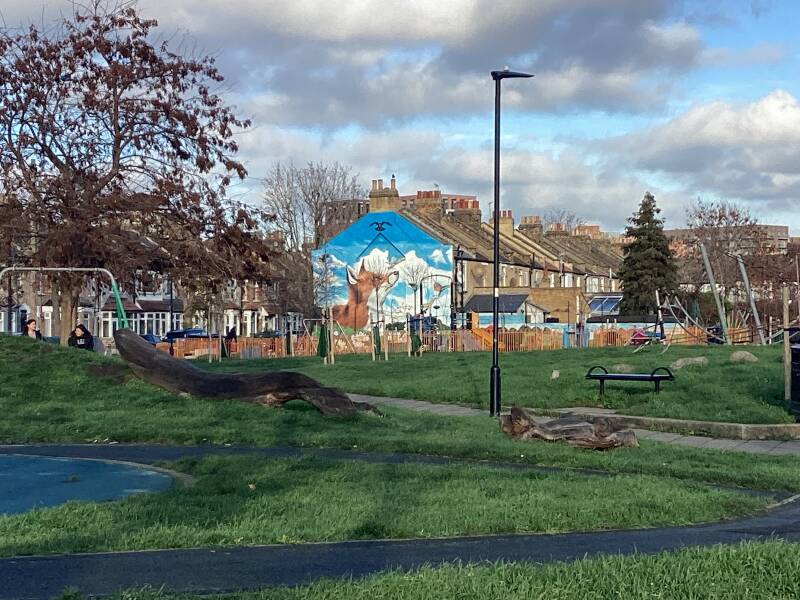
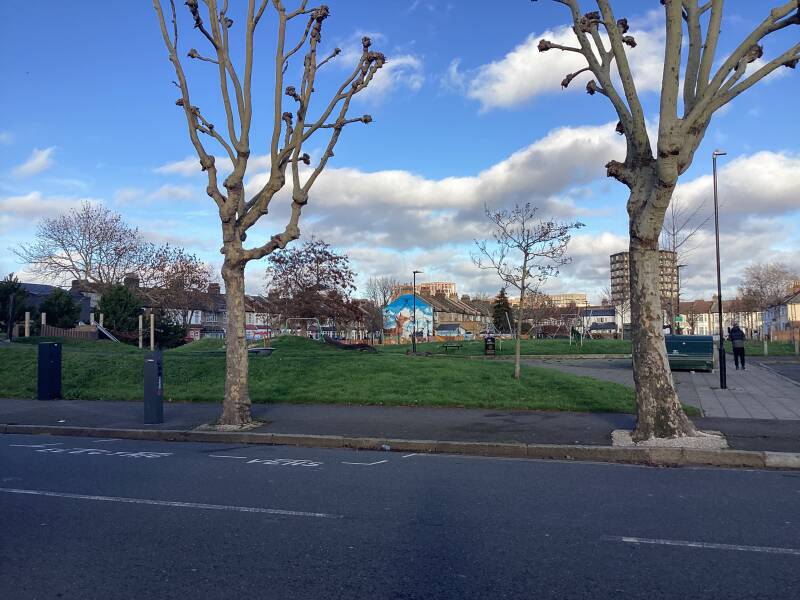
Cross Barking Road
Samson Road
Former PLAISTOW HOSPITAL (originally FEVER HOSPITAL, for infectious diseases)
The Hospital was one of the most modern of its kind, pioneering the barrier method of nursing infectious patients. It played a role also in the training of medical students.
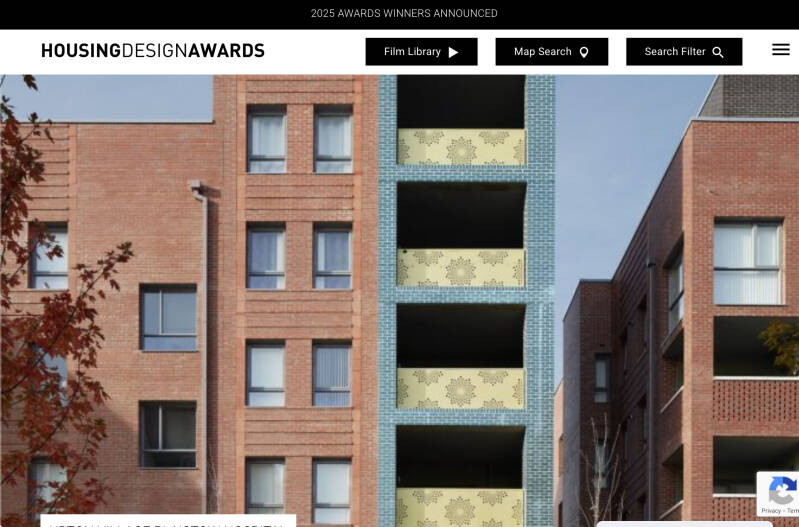
The former Plaistow Hospital site in Newham, East London, was redeveloped by Peabody Housing Association into a major housing scheme called Upton Village, providing around 168-169 mixed-tenure homes (affordable/private) with public gardens and communal spaces, transforming the derelict brownfield site into a modern residential community completed around 2017, blending new builds with preserved historic elements.
George Peabody St.
GEORGE PEABODY
Born Massachusetts, USA, descended from English immigrants to America. A merchant businessman who moved into banking, in partnership with J. S. Morgan and became extremely wealthy. First came to the UK in 1827. He never married but had a mistress and daughter in Brighton to whom he was generous during his lifetime but they did not figure in his will.
His philanthropy in America was focussed on education and in Britain on housing. In 1862 he created The Peabody Donation Fund and the first Peabody model housing block was opened in Spitalfields, followed soon by buildings in Chelsea, Bermondsey, Islington, and Shadwell. The Fund, now 'Peabody', continues to provide housing.
Peabody died at a friend's home at 80 Eaton Square. His will required that he be buried in his home town but first he was given a state funeral in Westminster Abbey and then his body was ceremonially shipped across to America where he was buried in the family tomb that he had himself built, at his home town that had, in 1868, been renamed Peabody.
PEABODY TRUST
It started over 160 years ago with one man, a £150,000 donation and a desire to improve the lives of poverty-stricken Londoners.
Southern Road
Eastern Rd.
St.Mary’s Rd
Former CHURCHYARD
In the green area, previously St Mary's churchyard. Enter from St Marys Road turn left just inside the gate The stone is almost at the boundary with the inscription facing away from you. The tombstone is of James Davis "of the Coach and Horses" who died in 1855. This pub still stands in Greengate Street, but (in 2007) is boarded up and has a For Sale board outside. The poem on the stone was not exactly chosen to provide good cheer. It reads:
Boast not Reader of thy might: Live at Morn yet dead at Night. Thy life hangs on a single thread, No sooner broke than we are dead.
The design on the stone which includes bunches of grapes may have been chosen because he was a publican
ST.MARY’s Church
It was built as a chapel of ease to All Saints Church, West Ham, then the only parish church in the area. It was promoted to a parish in its own right in 1844. The site was granted by Sir John H Pelly and the church designed in the neo-Gothic style influenced by the late Perpendicular style by Thomas Curtis. Notable among its vicars was Thomas Given-Wilson, who raised is capacity to 1,000 through a comprehensive rebuild.
Its Victorian building, designed by Sir Arthur William Blomfield in 1890-1894, was demolished in 1976.
CHURCH LODGE. Former GIRLS’ SCHOOL
Pelly Road
Sir John Henry Pelly, 1st Baronet of Upton, was born in 1777 – a year after thirteen British colonies in North America declared independence – and went on to lead an exceptional life.
His family estate was centred on the lush fields and fertile farms of what is now Upton Park.
As a young man, he joined the Hudson’s Bay Company – a vast trading organisation that explored, and exploited, huge parts of Canada.
Richmond St.
THE BLACK LION P.H.


On the corner of the High Street and Richmond Street. This pub dates back at least to the early 1700s. It has been much altered over the ages, but the square doorway to the left of the left hand picture was built to enable horse-drawn carriages to enter into the cobbled courtyard. In 1809 the Pub was mentioned in a court case at Chelmsford Assizes. On Whit Monday of that year, a public holiday, there were plans to run races from the Greyhound to the Black Lion and also to have various games. Some of the more serious minded inhabitants of the village, fearing that this was an attempt to restart a previously banned annual fair held opposite the Greengate Pub, published notices saying that the races were illegal. On the day, about 200 people turned up and several magistrates and constables attempted to stop the fun. The result was a fracas which lasted all afternoon and several people were charged with riot and conspiracy. The judge dismissed the charges saying that races did not constitute a riot
WEST HAM PARK
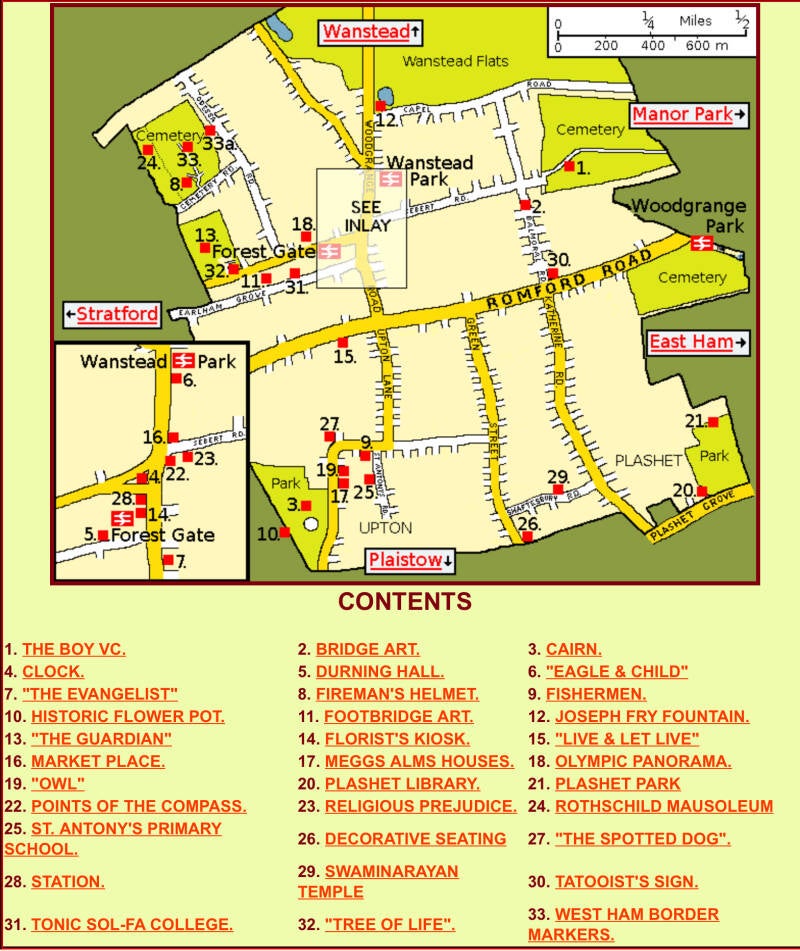
Upton Lane
Site of UPTON HOUSE
now the corner of Lancaster Road and Upton Lane[1] It was rebuilt in 1731.[2] In 1827, it was the birthplace of the surgeon Joseph Lister. In 1893 a temporary church for St Peter's Church, Upton Cross was set up in its gardens, with the house forming the vicarage[2] - the permanent church was later built in the gardens. The vicarage was demolished in 1967-1968[2] and its site is now occupied by Joseph Lister Court.
Former THE SPOTTED DOG P.H.
The Old Spotted Dog on Upton Lane, Forest Gate, is a Grade II listed historic pub, possibly a 15th-century Tudor hunting lodge for Henry VIII, evolving into a coaching inn and later a beloved, if dilapidated, community hub, particularly for Clapton FC, before closing in 2004 and facing dereliction, prompting campaigns and recent planning approval for major restoration as a hotel, flats, and community asset.