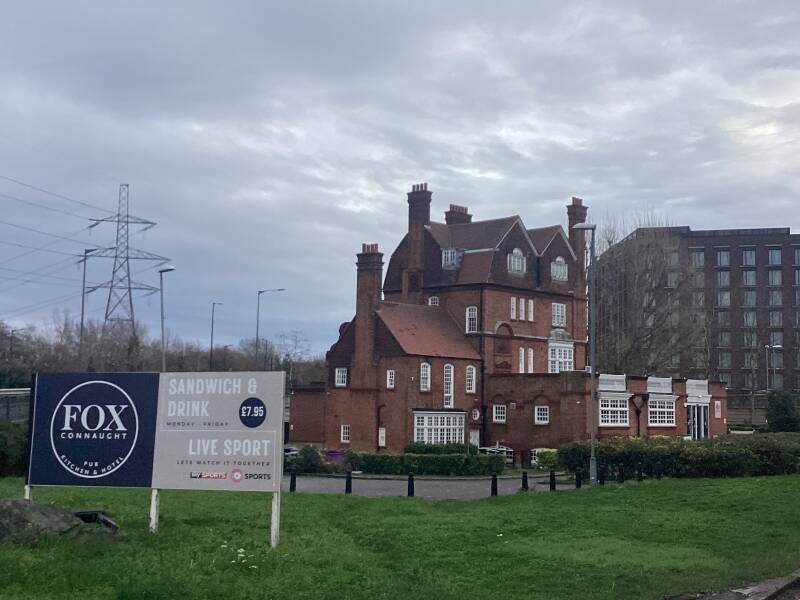
Two start points Two routes: from City Hall and from Fox Connaught (Excel)

Due North: CITY HALL (ROYAL DOCKS) to CANNING TOWN, PLAISTOW, WEST HAM PARK STRATFORD NEW TOWN and OLYMPIC PARK

To your left (West): the LEA RIVER VALLEY
Lower Lea Crossing
Silvertown Way
A first in road history.
Yes, that’s the Silvertown Viaduct flying over the large Tidal Basin Roundabout and at 90 years old, it’s also the UK’s first purpose-built flyover.
To explain, we need to go back to the turn of the 20th century when this part of London was bustling with the warehouses and industry of the docks that supplied London.
The ROYAL VICTORIA. dock entrance was also built into this congested landscape, prioritising boats and causing massive traffic jams on the overcrowded roads. It was estimated that businesses were losing around £1,000 per day because of delays caused by boats going through the dock gates and blocking the road bridge over the dock entrance. Eventually it got so bad that in 1926, a Royal Commission on Cross River Traffic investigated how to improve things. One of its recommendations was for a “giant highway into dockland,” which would cost around £2.5 million to build. In August 1928, the London County Council agreed with the report and submitted the necessary papers to Parliament for permission to build it.
some 3,600 people packed into 500 homes were moved out, with 600 replacement homes needing to be built elsewhere to rehouse them.
the viaduct itself, concrete was used initially because it was thought it would look nicer, but also as works progressed, because it was cheaper than steel. However, they used steel where the viaduct passed over the railway, to avoid long disruptions.
The Silvertown Viaduct was finally opened to road traffic by the Minister of Transport, Mr Hore-Belisha on Thursday 13th September 1934.
Views
LIMMO PENINSULA
Site of Thames Ironworks
The Thames Ironworks and Shipbuilding Company, Limitedwas a shipyard and iron works straddling the mouth of Bow Creek at its confluence with the River Thames, at Leamouth Wharf[1](often referred to as Blackwall) on the west side and at Canning Town on the east side. Its main activity was shipbuilding, but it also diversified into civil engineering, marine engines, cranes, electrical engineering and motor cars.[2]
The company notably produced iron work for Isambard Kingdom Brunel's Royal Albert Bridge over the Tamar in the 1850s,[2] and the world's first all-iron warship, HMS Warrior, launched in 1860
The company originated in 1837 as the Ditchburn and Mare Shipbuilding Company, founded by shipwright Thomas J. Ditchburn and the engineer and naval architect Charles John Mare. Originally located at Deptford, after a fire destroyed their yard the company moved to Orchard Place in 1838.Ditchburn and Mare were among the first builders of iron ships in the area; their partnership commenced with the construction of small paddle steamers of between 50 and 100 tons, before progressing to cross-Channel vessels and by 1840 were building ships of more than 300 tons.
customers included the Iron Steamboat Company and the Blackwall Railway Company. contracts by the Admiralty
From 1847, coinciding with the retirement of Ditchburn, the company grew considerably and Mare purchased land in Canning Town
Mare constructed a yard with furnaces and rolling mills that could construct vessels of 4,000 tons. In 1853 the company launched the SS Himalaya for the Peninsular and Oriental Steam Navigation Company, briefly the world's largest passenger ship
In 1855, the company which by now had more than 3000 employees, was threatened with closure following Mare's bankruptcy Not because they lacked orders.
MARE & CO. were awarded the contract for Westminster Bridge(which was built in 1862).
The main figure in saving the company was Peter Rolt, Mare's father-in-law and Conservative MPfor Greenwich. Rolt was also a timber merchant and a descendant of the Pett shipbuilding family. He was supported in the venture by another company director, Lord Alan Spencer-Churchill.
Rolt took control of the company's assets and in 1857 transferred them to a new limited company, named the Thames Ironworks and Shipbuilding and Engineering Company Ltd..
The new company was the largest shipbuilder on the Thames, its premises described by the Mechanics' Magazine in 1861 as "Leviathan Workshops"
One of its first Admiralty contracts was for HMS Warrior, launched in 1860, at the time the world's largest warship and the first iron-hulled armoured frigate. navies all over the world
General shipbuilding on the Thames came under great pressure due to the cost advantages of northern yards with closer supplies of coal and iron,
In the 1890s philanthropist Arnold Hills became the managing director. He had originally joined the board of directors in 1880 at the age of 23. Hills was one of the first business directors voluntarily to introduce an eight-hour day for his workers at a time when 10- and 12-hour shifts were more common.
In 1911 Hills petitioned Winston Churchill, then First Lord of the Admiralty, regarding the lack of new orders. He was unsuccessful, and the yard was forced to shut in 1912
In 1895 Hills helped to set up a football club for the Works' employees, Thames Ironworks F.C. and within their first two years they had entered the FA Cup and the London League. As a result of the committee's desire to employ professional players, the Thames Ironworks F.C. was wound up in June 1900 and West Ham United F.C. was formed a month later.
Recent past a future
The site was used as construction staging for the Jubilee Line Extension in the 1990s and the Docklands Light Railway extension to City Airport in the 2000s, before being used as the primary work site for the eastbound tunnel boring machines for Crossrail in the 2010s.
Archaeologists working on the Crossrail site in 2012 uncovered remains of the Thames Ironworks and Shipbuilding Company.
In 2018, Sadiq Khan announced that, following the completion of Cross- works in 2018, the 12-acre site would be developed for housing – with over 1,500 new homes. The site is currently owned by Transport for London, with income from the project reinvested into the transport system.
Places for London - TfL's wholly owned property company - announced, that Ballymore has been selected as the joint venture partner for its development at Limmo Peninsula, as they look to bring new affordable, market and rental homes to east London.
Jubilee Line Headhouse
It’s the mouth of the Jubilee Line tunnels. Once you go in here, there is tunnel all the way to Finchley Road.
The structure incorporates flood gates, and according to this website may have been purposely designed to resemble the nearby Thames Barrier. n.
Residential
Canning Town L.U and DLR Station
The first station, originally named Barking Road, was opened on 14 June 1847 by the Eastern Counties and Thames Junction Railway on the south side of Barking Road[15] in the Parish of West Ham. It was renamed Canning Town on 1 July 1873,[16]and in 1888, this station was closed, being replaced by a new station on the north side of Barking Road[17] (near Stephenson Street). The booking hall was replaced in the 1960s, and survived until 28 May 1994. The station was served by trains on the North London line to North Woolwich.
The new station was built on the south side of the A13, designed by Troughton McAslan. The tiered design of the station placed the DLR platforms directly above the Jubilee line platforms allowing for easy interchange. the station is connected by an underground concourse stretching the width of the site and connected to all platforms and the bus station by escalators, stairs and lifts. A substantial bus station was also built as part of the station complex.
The DLR platforms opened on 5 March 1998.[23][24] With the opening of the Jubilee line platforms on 14 May 1999, the new station complex was complete.
The North London Line platforms closed on 9 December 2006 as part of the closure of the Stratford to North Woolwich section of the line. On 31 August 2011 these platforms re-opened on the new Stratford International branch of the Docklands Light Railway
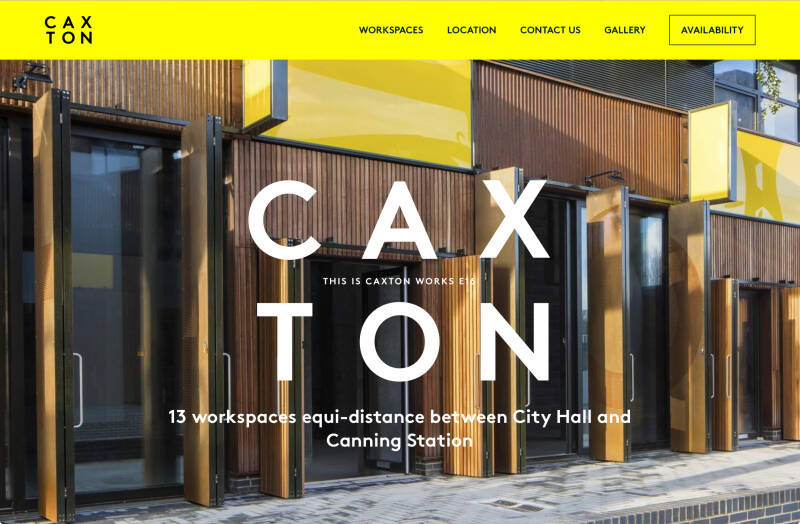
East of Silvertown Way: Caxton Works
East of Silvertown Way: Hallsville Quarter, retail & residential
DICK TURPIN HOUSE?
Oak Cresc.
Wonderful Women
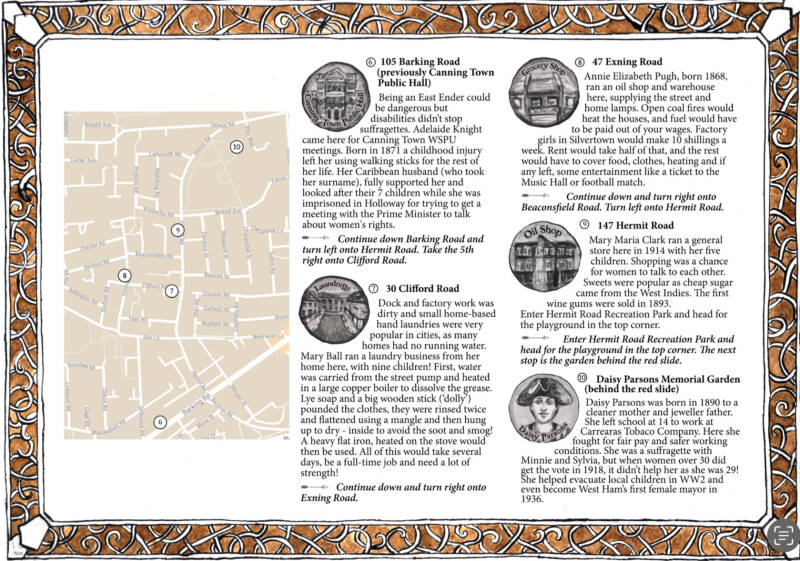
Clifford Rd.
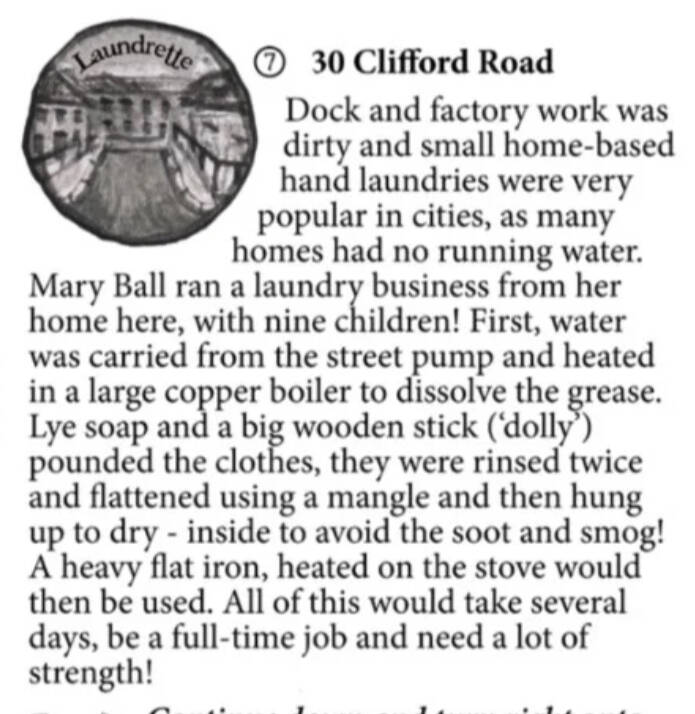
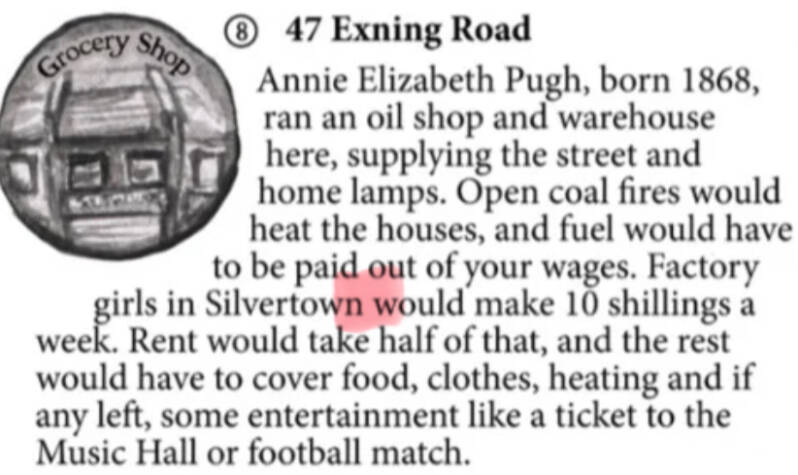
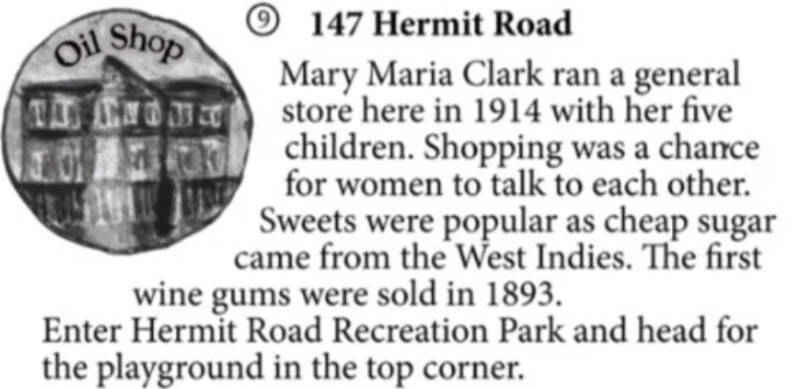
Malmesbury Road Park
STAR PARK
HERMIT ROAD RECREATION GROUND
WHUFC: the first home ground of football club Thames Ironworks.
DAISY PARSONS MEMORIAL GARDEN
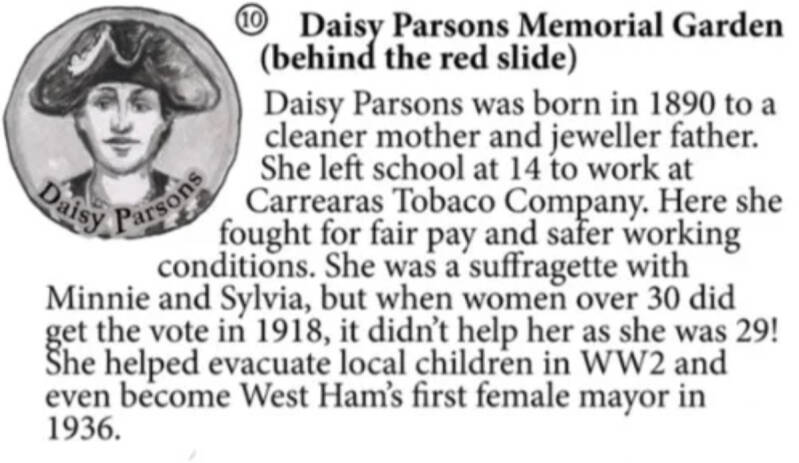
MEMORIAL RECREATION GROUND
The eleven steel posts are laid out on the construction lines of the deck of HMS Albion, a cruiser built by the Thames Ironworks. At its launch in 1898 into Bow Creek, 38 people died as the tidal wave created by the launch caused chaos for the spectators close to the water. Many of the dead from this tragic event are buried in the cemetery next to the Park . This kinetic work is a memorial to those victims but also marks a once great local industry and the craft of its workers, bringing back the clang of hammer on steel.
After being evicted from their previous permanent home at Hermit Road in October 1896, Thames' chairman Arnold Hillsleased a temporary piece of land for the team at Browning Road, East Ham. However, the new situation was not ideal, so Hills earmarked a large section of land in West Ham for a new stadium to be built upon. The new home cost £20,000 of Arnold Hills' own money to build.[1]
The Memorial Grounds was opened on Jubilee Day, 22 June 1897, to coincide with the sixtieth anniversary of Queen Victoria's coronation. Aside from a football pitch, the stadium contained a cycle track, a cinder running track, tennis courts and one of the largest outdoor swimming pools in England. It was said at the time that the grounds, with a capacity of 100,000 spectators, were "good enough to stage an English Cup Final."
Arnold Hill and a young Gandhi: vegetarian diet & football
Arnold Hills was a British businessman and social reformer who served as the first president of the London Vegetarian Society (LVS), on whose executive committee the young Mahatma Gandhi also served while studying law in London.
Hills and Gandhi bonded over their shared belief in vegetarianism. Hills was a passionate advocate for a plant-based diet and total abstinence from stimulants, beliefs that resonated strongly with Gandhi's personal vows.
Arnold Hills remained a significant figure in the vegetarian movement, founding the magazine The Vegetarian and the Vegetarian Federal Union.
During Gandhi's time as a law student in London (1888-1891), Hills inducted him onto the executive committee of the LVS, a society Hills also heavily financed.
Hills was also the managing director of the Thames Iron Works and a key founder of the Thames Ironworks F.C. (which later became West Ham United). Gandhi was reportedly a keen football fan and is said to have visited the Boleyn Tavern (a popular pub near the club's old stadium) and possibly attended games during a later visit to London in r
Community Sports
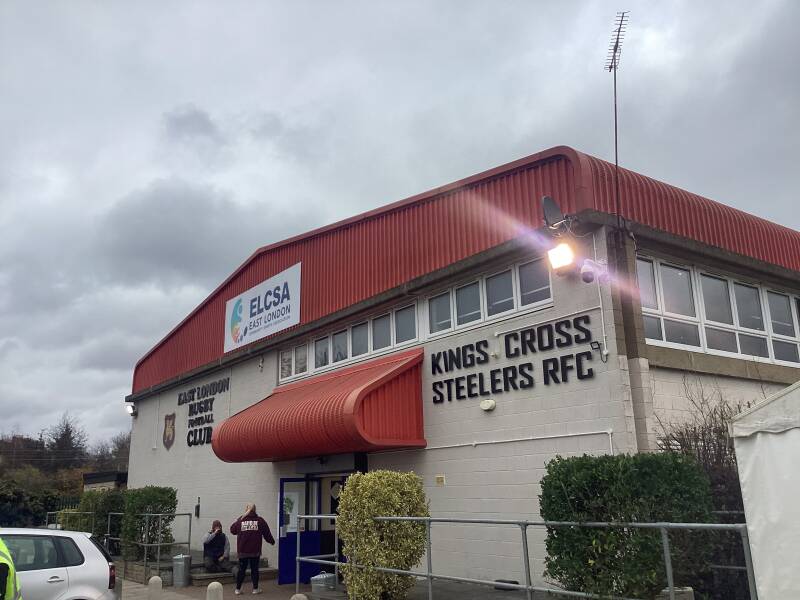
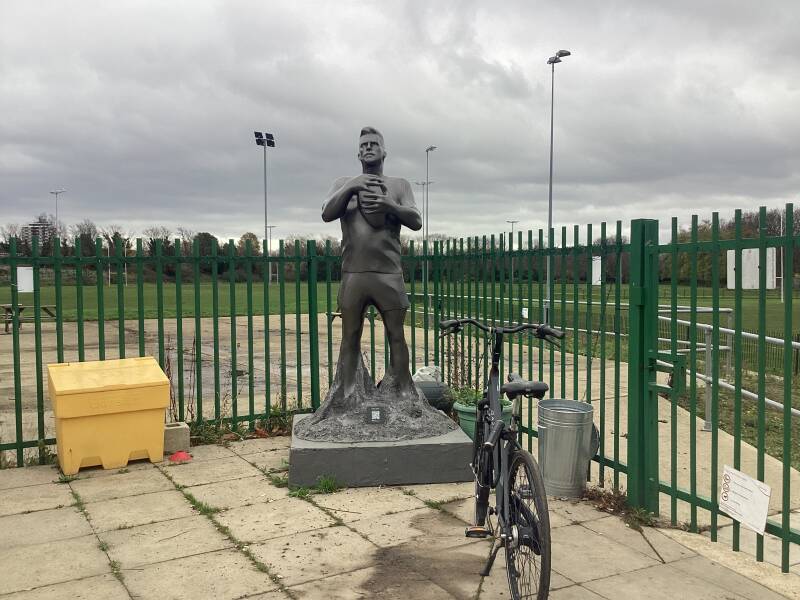
In 2003 Cyril Leroy set up France’s first LGBTQ+ rugby team: Les Gaillards. ‘Although I loved watching rugby on TV, I never thought I could ever play it’. As a gay man, Cyril didn’t feel comfortable to join an existing ‘straight’ rugby club, so he decided to create his own inclusive club set up for LGBTQ+ members. 20 years later the club is still going strong, providing people from the LGBTQ+ community the opportunity to play in a team they feel represents them.
Grange Road
EAST LONDON CEMETERY
Memorial to the 550 victims of the 1878 SS Princess Alice disaster.
Memorial, marked by a ship's anchor, commemorates those who died when the staging collapsed during the launching of HMS Albion in 1898
A further disaster, the Silvertown explosion of 1917, is commemorated in the grave of Andrea Angel, chemist at the Brunner Mond chemical works, whose TNT plant exploded, damaging up to 70,000 properties in the area, killing 73 people and causing over 400 casualties.
Carl Hans Lody – the first person to be shot during World War I in the Tower of London as a spy is buried under his own black headstone. Ten other German spies shot in World War I are buried under a small memorial stone about 150 yards from Lody's grave, next to a pathway
Upper Road
GREENWAY (or, as it was called then, the SEWERBANK)
In 1931 Mahatma Gandhi visited London for a period of 3 months for talks on the future of India, he based himself at Kingsley Hall in Bromley-by-Bow. His host there, the Christian Socialist Muriel Lester described his long early morning walks, beginning before sunrise, and which often took in the Sewerbank through Stratfordto Plaistow. Gandhi enjoyed the elevated view the bank offered, and on these walks he would always gather a collection of well-wishers eager to speak to him.
LISTER GARDENS
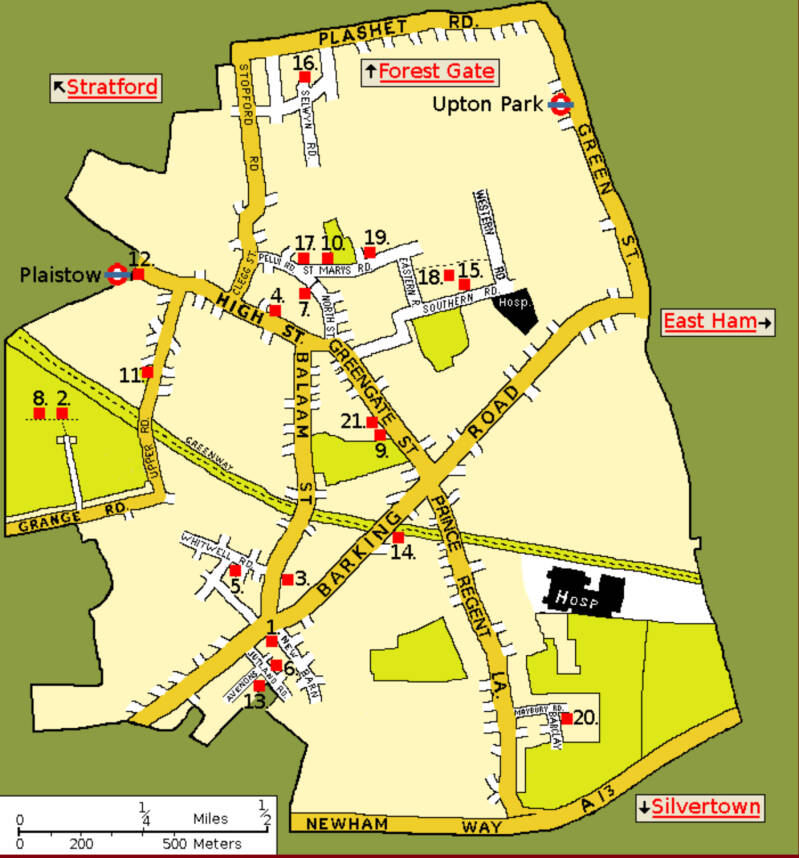
Florence Road. Two pairs of gates specially designed for this small park. The gardens are named after Lord Lister (1827-1912) who introduced the first antiseptic procedures into hospitals. He therefore revolutionised modern surgery. Lister was born in Upton House which used to stand in Upton Lane, facing the present West Ham Park. These gardens compensate rather inadequately for the council's failure to stop Lister's house from being pulled down. (See No. 11. on the MAP )
Artist: Daksha Amin.
Lister was born to a prosperous, educated Quaker family in the village of Upton . Upton House that by then stood on Upton Lane at what is now the corner of Lancaster Road. Joseph Lister, who pioneered antiseptic surgery, was born at this Upton House, which is shown in the watercolour on the right.
Former ST.MARY’s HOSPITAL for Women and CHILDREN’S, now LADY HELEN SEYMOUR HOUSE
Currently. used by East Potential as a hostel for local homeless young people who require support, either for employment, education or training.
PLAISTOW
The first recorded use of the name Plaistow was in 1414. The area was also known as Sudbury because it was the Southern manor of Ham. A tow or stow is Old English, meaning a fenced off place. Hugh de Plaiz owned this manor in late Norman times. (A similar occurrence of this in East London is in Walthamstow). Plaistow was on the edge of solid ground bordering one the marshes beside the Thames. The marshes provided rich agricultural ground. A prize ox which had grazed on One Tun Marsh near Plaistow was sold at Leadenhall market in 1720, which was said to be exceptionally heavy.
Plaiz or Plaitz, in 1065, married Philippa de Montfitchet, of the Mountfitchet Castle family, who owned the district. It is she who is reputed to have named it the Manor of Plaiz.
De Montfitchet (de Montfichet, de Mountfitchet) family were of Norman origin, probably from the town of Montfiquet. Robert Gernon (Robert of the Moustache) received manorial lands in Essex in reward for his service prior to publication of the Domesday Book in 1086,[1] and his family were subsequently based there, initially in the castle at Stansted Mountfitchet.
Amongst their accomplishments, the family founded Stratford Langthorne Abbey, which became the fifth largest in England. The links with the area were preserved even after the family disappeared, and the de Montfitchet coat of arms figured in the insignia of the County Borough of West Ham. Monfichet Road in the Queen Elizabeth Olympic Park at Stratford is named after the family. So are Montfichet's Tower in London, and the Essex town of Stansted Mountfitchet, with its partially reconstructed Castle Mountfitchet.
A FANTASTIC WEB COVERING EAST LONDON: http://www.exploringeastlondon.co.uk/eel/Plaistow/Plaistow.htm#Lister
Plaistow High St.


Clegg St.
Pelly Road (crossing the railtrack)
Stratford Road
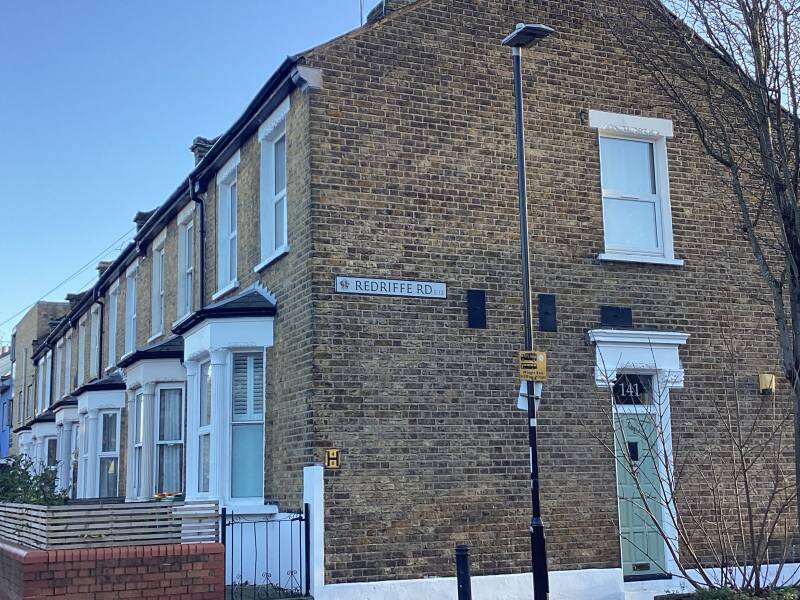
REDRIFFE ROAD?

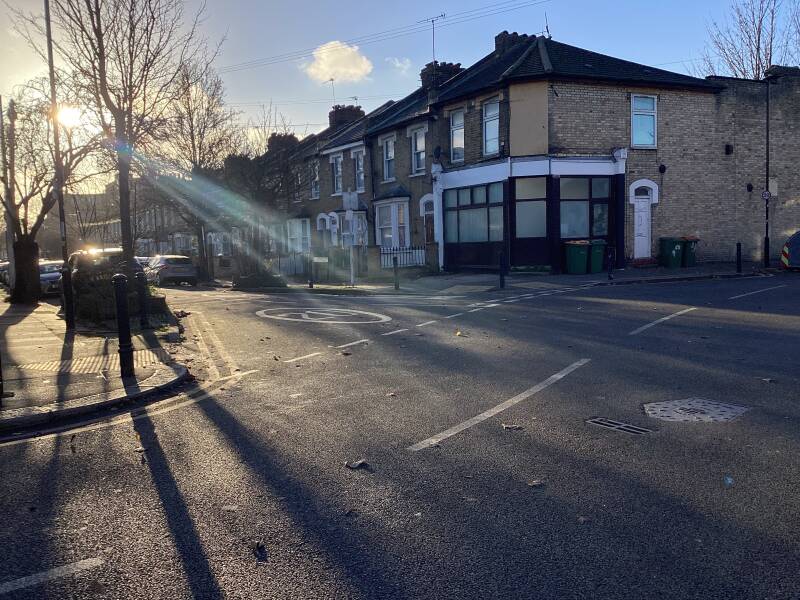
Caistor Park Road
Portway
COLNES Army Cadets
Territorial Army. G Company 7th Battalion The Rifles
WEST HAM PARK
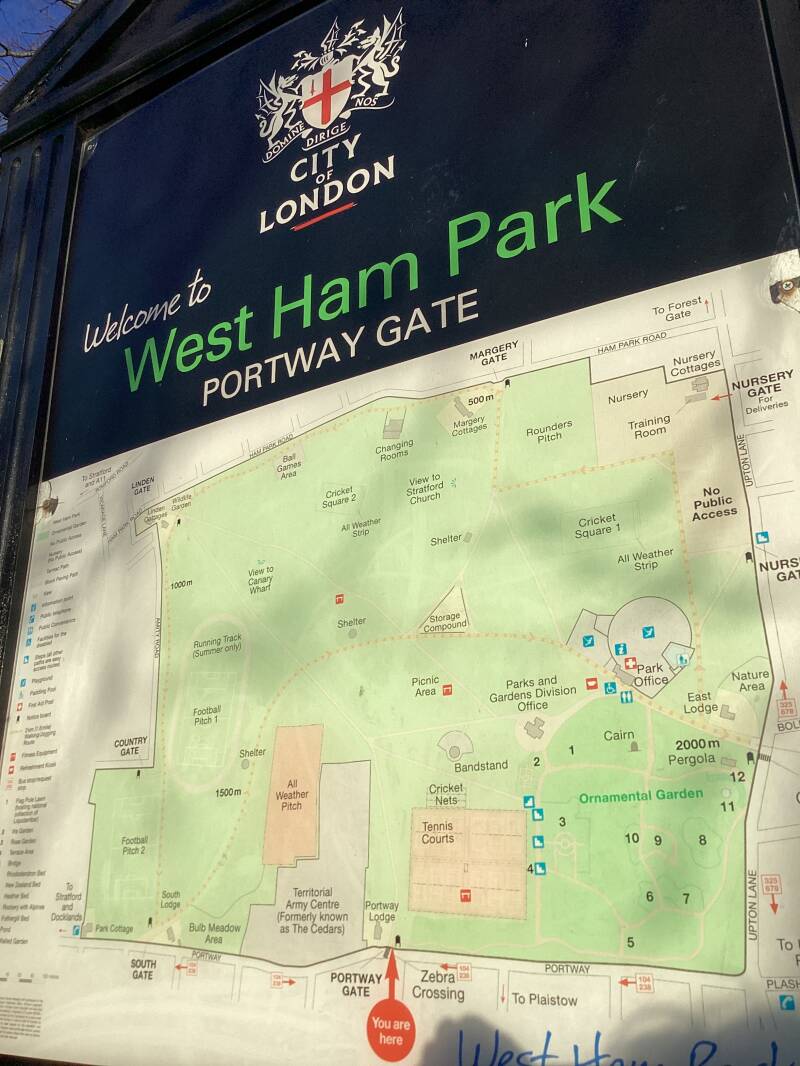
Records from 1566 show that the park had been a part of the estate of Upton House, later known as Ham House. William Rooke, who had inherited the estate, enlarged it to 28 acres (11 ha) in 1559. The estate was purchased by John Elliott in 1752, who owned it for 10 years. It was acquired in 1762 by John Fothergill, who enlarged the grounds to around 80 acres (32 ha) and created a sizeable botanical garden, which had been described as 'second only to Kew'. He would often accept rare plants in lieu of his fees as a physician. After Fothergill's death in 1780, the contents of the garden were largely sold off.[2][3][4]
The estate was sold to James Sheppard in 1787, and after his death was purchased by Samuel Gurney, his son-in-law, in 1812. During this period, Gurney's sister, Elizabeth Fry, resided there. It was later passed to John Gurney, who lived in Norfolk and had no use for the estate. Ham House was demolished in 1872. In 1874, John Gurney gave a large contribution towards the purchase of the Ham House estate and grounds by the Corporation of the City of London, to serve as a public open space.[3]
The park was the home to Upton Park FC, a local football club that drew large crowds at home matches.[5] The venue was the site of the first ever FA Cup goal, scored by Jarvis Kenrick for Clapham Rovers in a 3–0 victory over Upton Park on 11 November 1871.
Elizabeth Fry (1780-1845) was a Quaker minister and prison reformer.
She married Joseph Fry, son of the owner of Plashet House (PLASHET, its site is now occupied by Victorian terraced streets) , and lived there from 1809-1828.
From here in 1813 she began the work to reform the conditions of women and children in prison which became a life-long campaign involving journeys throughout the British Isles and on the Continent.
After the failure of her husband’s business in 1828 she lived at Upton Lane House (later called the Cedars) in Portway, West Ham, and continued her work from there until 1844.
She was visited there by Fredrick William IV of Prussia in 1842.
Tavistock Road
Romford Road
Vicarage Lane REPAIR SHOP
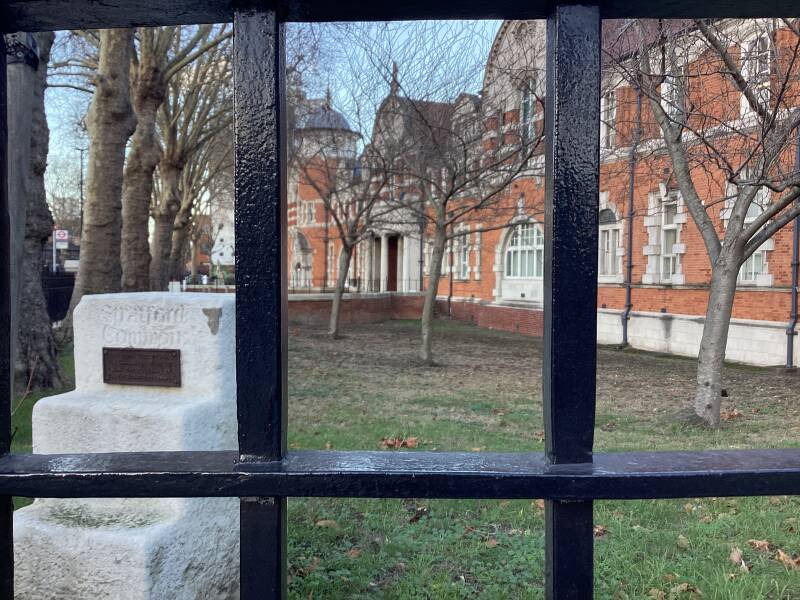
STRATFORD COMMON or STRATFORD GREEN
Executions, here?…THE STRATFORD MARTYRS
The most notable executions in Stratford were the Stratford Martyrs, where eleven men and two women were burned at the stake for their Protestant beliefs on June 27, 1556, during the reign of Queen Mary I ("Bloody Mary").
- The exact site is disputed, but the most likely locations are thought to be Fair Field in Bow (then known as Stratford-le-Bow) or Stratford Green, where the University of East London Stratford Campus now stands. The area of Stratford Green was also known as Gallows Green.
- The Victims: The 13 individuals were tradesmen (including a blacksmith, brewer, and weaver) who had been arrested across Essex and Hertfordshire and charged with heresy.
- The Event: The condemned were brought from Newgate Prison in London to Stratford. The eleven men were tied to three stakes, and the two women were left loose in the midst of a single fire. One of the women was pregnant.
- The Crowd: The executions were a public spectacle, reportedly attended by a crowd of over 20,000 people.
- The Memorial: In 1879, a large Gothic-style monument was erected in the churchyard of the Parish Church of St John the Evangelist on Stratford Broadway to commemorate the martyrs.
THE QUADRANGLE
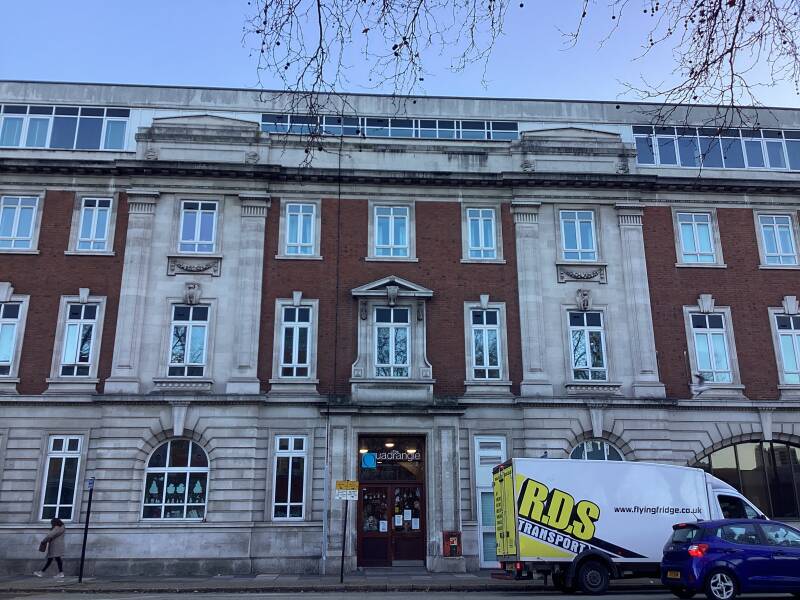
The building, constructed around 1930, was originally designed and used as a grand electricity showroom and headquarters for the County Borough of West Ham electricity department. The building has a distinctive and grand façade with carved features and high ceilings, reflecting its original public purpose.
Former BOW COUNTY COURT
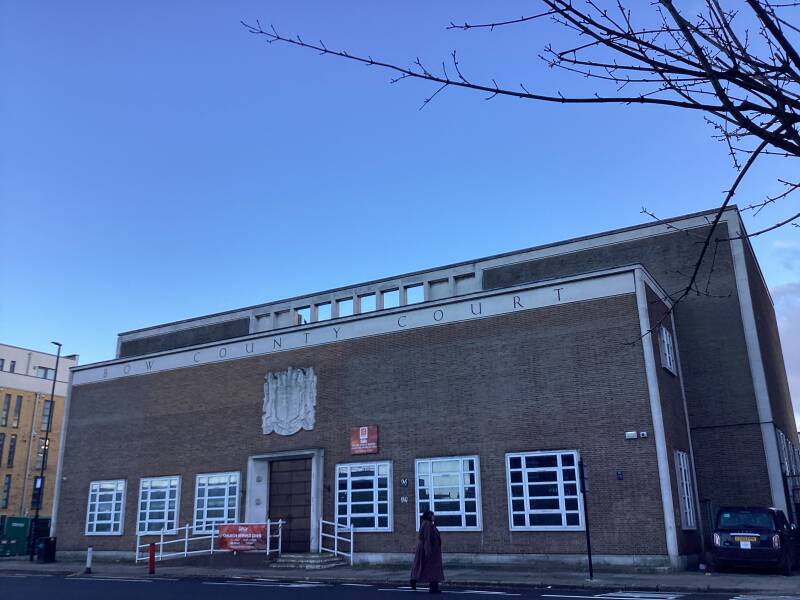
The court was closed by the Ministry of Justice and sold to The Redeemed Evangelical Mission, a church organisation, for £3.5 million in 2017.
The church submitted a planning application to Newham Council to create a "heritage hub" within the building, including a cafe, offices, and a 300-person capacity space. This proposal faced some opposition from local residents regarding the need for more places of worship in the area.
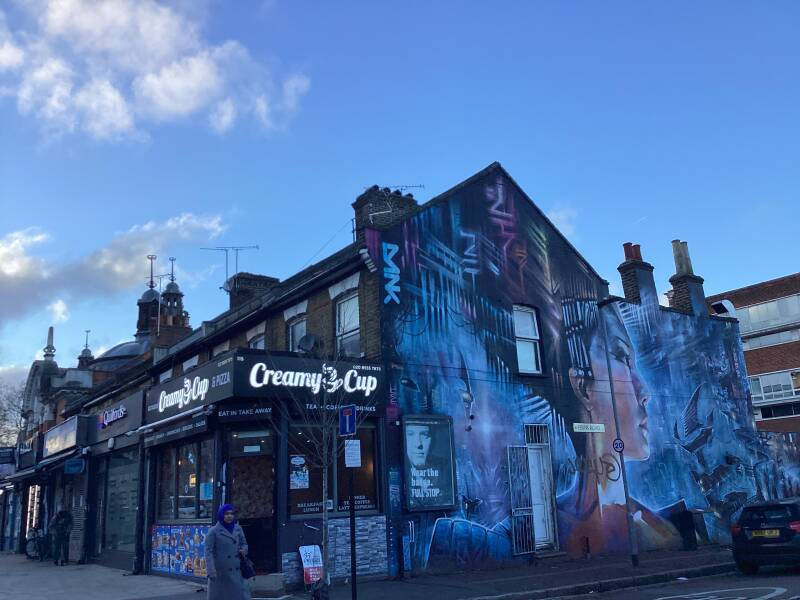
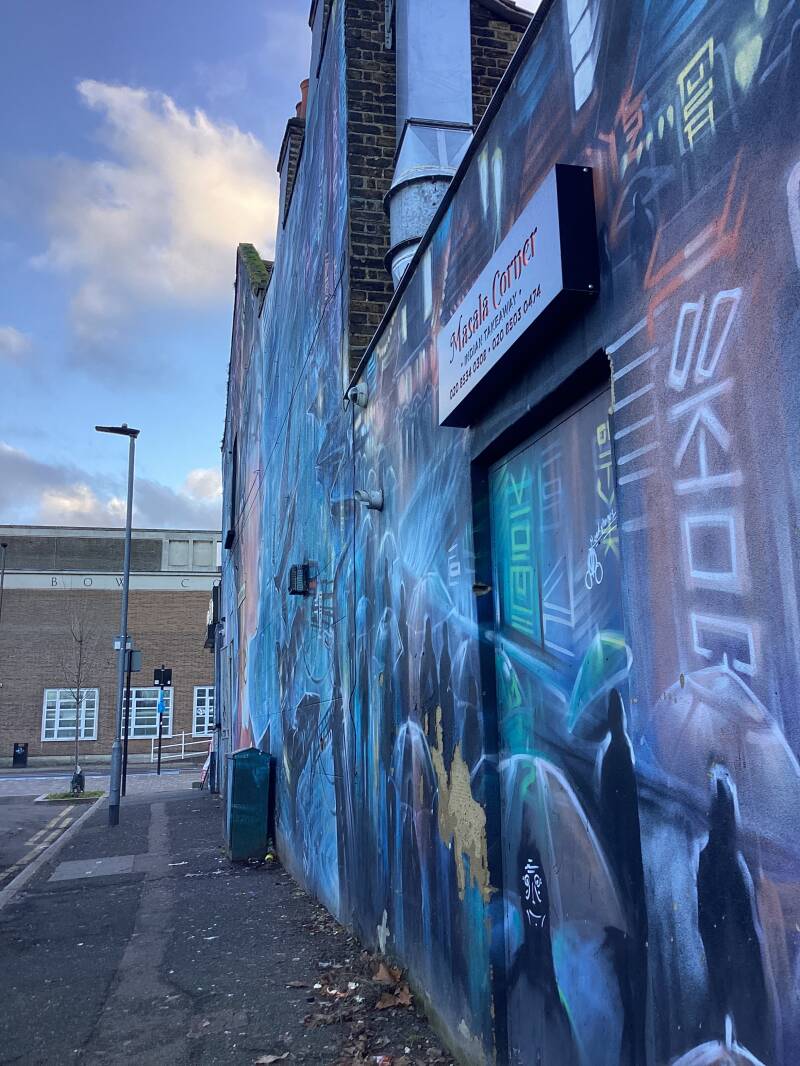
UNIVERSITY OF EAST LONDON, Stratford Campus
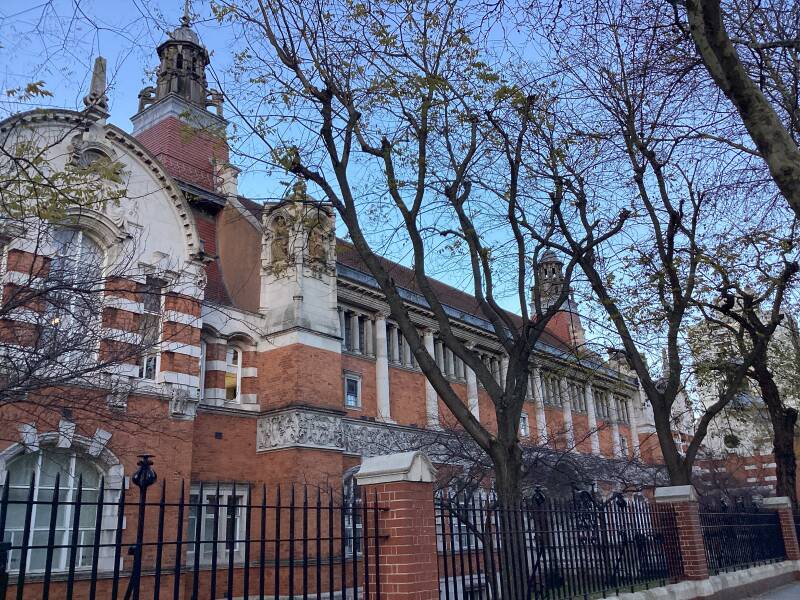
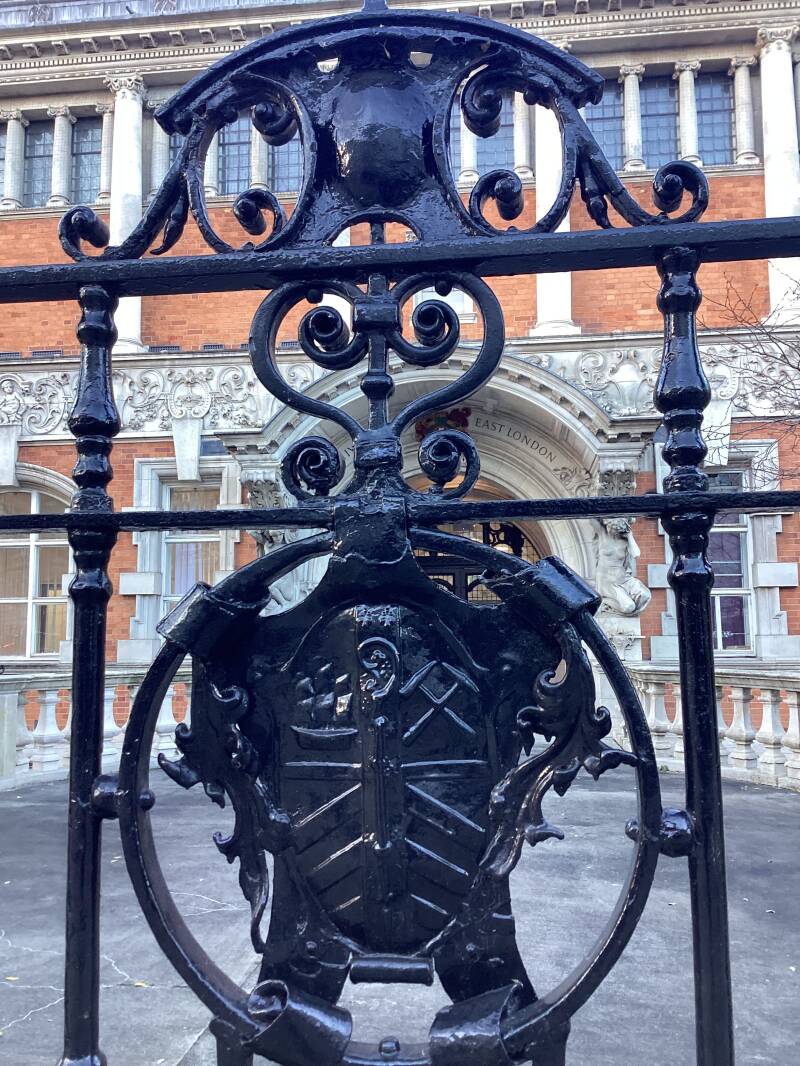
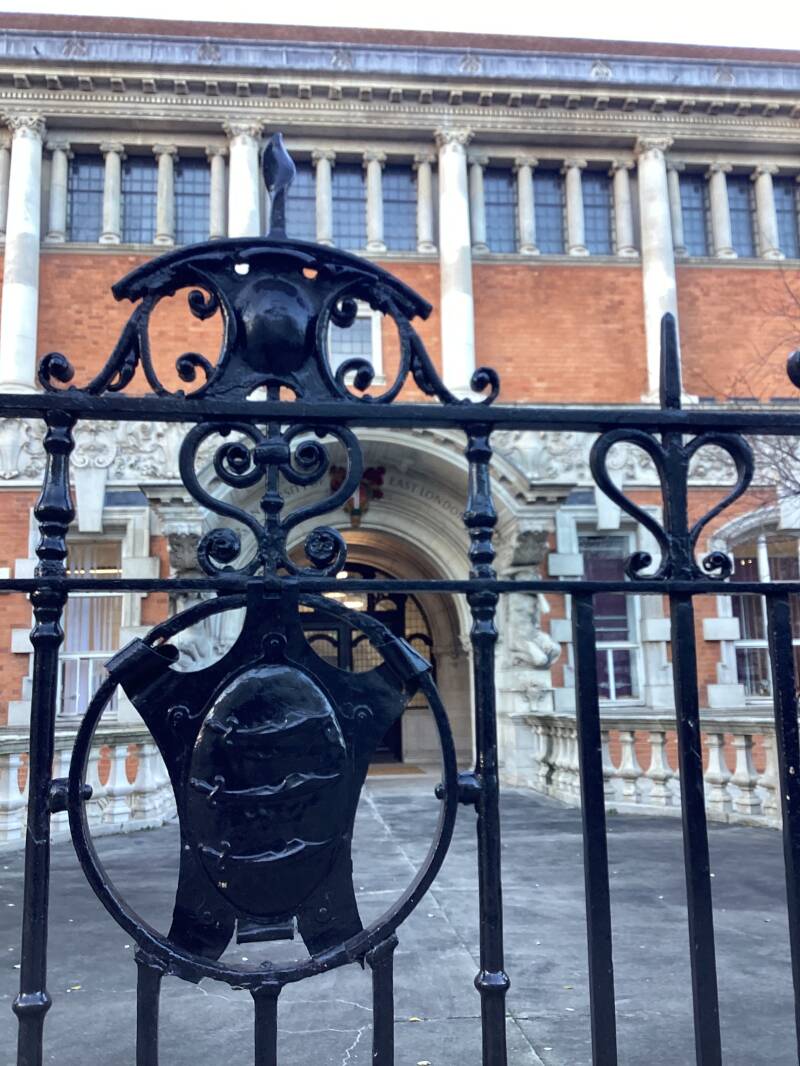
The University of East London began as the West Ham Technical Institute and it was officially opened in October 1898 after approval was given for the construction of the site by the West Ham Technical Instruction Act Committee in 1892 following the Technical Instruction Act of 1889.
The college provided courses in science, engineering and art, and also established its own internal degree courses in science and engineering, which were ratified by the University of London. In addition, it had a women's department.[3]
As demand for technical education grew throughout the 1930s and 1940s, Essex County Council created two further colleges at Walthamstow and Dagenham (South West Essex Technical College and South East Essex Technical College).[4] In 1970 these three colleges[4] (West Ham, Walthamstow, Dagenham) were combined as a merger of higher education colleges, to create the North East London Polytechnic.
In 1988 the North East London Polytechnic became a higher education institution, and was renamed the Polytechnic of East London in 1989
It gained university status in 1992.
Barking Campus (closed 2006)[7]and the Stratford Campus. In 1999 the Docklands Campus was opened, the first new university campus built in London for over 50 years.
The community is made up of over 40,000 students from over 160 countries
PASSMORE EDWARDS’ contribution: former MUSEUM
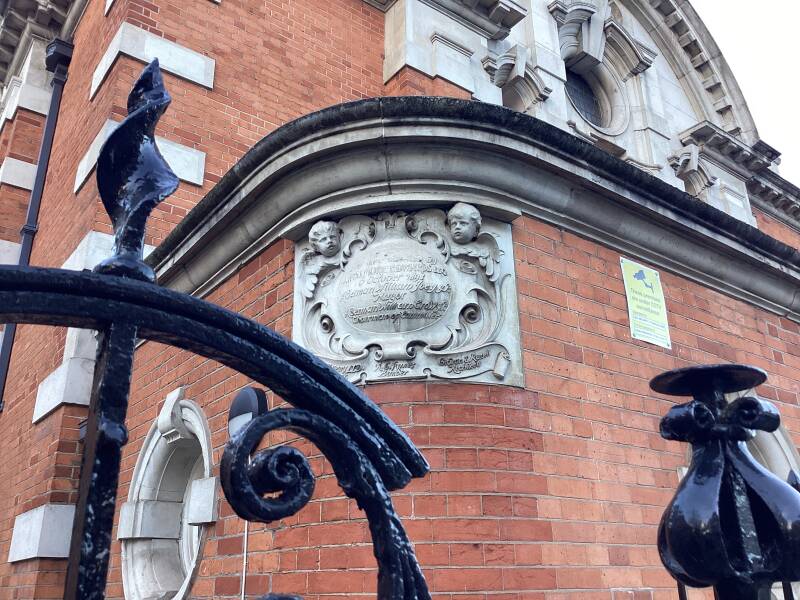
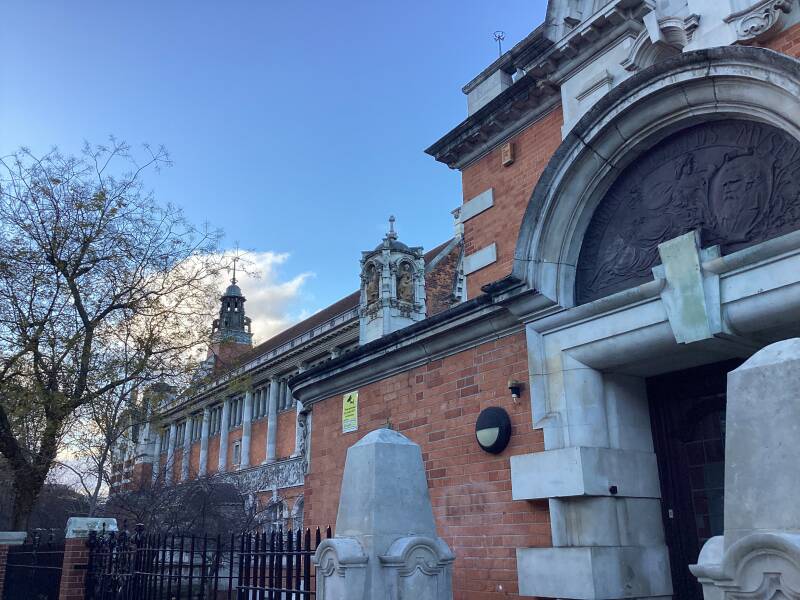

Passmore Edwards was a Victorian philanthropist who funded many public buildings in Cornwall and London. John Passmore Edwards's key contribution to West Ham's educational landscape was funding the Passmore Edwards Museum, which was built as part of the West Ham Municipal Technical Institute (later West Ham College/UEL), providing a crucial public space for learning, science, and art, fulfilling his vision of a "people's university" in the area, though the museum later closed and was repurposed. He also supported the West Ham Hospital with a new wing, showing his broad philanthropic impact on community facilities.
PASSMORE EDWARDS ALL-LONDON WALK: https://www.southlondongallery.org/projects/john-passmore-edwards-walk/
Water Lane
MARYLAND POINT
Maryland in East London likely got its name from a wealthy merchant who returned from the American colony of Maryland, naming his new estate "Maryland Point" around the late 17th century, though some theories suggest Old English origins related to boundaries. It first appeared on maps around 1696, near Stratford, and the area developed with housing for railway workers, eventually becoming a well-known district with its own station.
THE CART AND HORSES P.H.


You can divert (or make a short detour) now, towards STRATFORD
The Grove
PICTURE HOUSE
Grove Picture House was built by the Frazzi Fireproof Construction Company Ltd., and opened in 1910. It was one of the earliest Cinema buildings in the Country. The ticket office was in the centre of the facade and can still be seen today, indeed the facade of the building is still as it was in 1910
The Cinema was later converted into a Billiard Hall but is today in use as a Health Centre.
CENTRAL BAPTIST Church
Stratford's Central Baptist Church originated in 1852 and was the first Baptist church in Stratford. The congregation has continuously occupied the site since the current building was erected shortly after. The church was founded in October 1852 by the Reverend George Fishbourne, a former minister at Bow Baptist Church, a schoolmaster named Joseph Freeman, and other members. Initial services were held in Rokeby House.
The land at The Grove was purchased in August 1854 for a significant sum, and the original "Stratford Grove Church" building was erected on this site. The cost of the building resulted in considerable debt that took many years to repay.
The church was known as the Grove Church for some time before officially receiving its present name, "Central Baptist Church," in 1917.
Like many churches in East London, it faced challenges during the mid-20th century due to the war, including physical damage and poor attendance, which caused many other local churches to close. Central Baptist Church, however, endured, a fact its members attribute to the faithfulness of God, a message displayed on a banner in front of the church.
The church has remained a consistent presence in the rapidly developing East London area, adapting alongside significant population increases and urban changes since the mid-19th century.
ST.FRANCIS OF ASSISI R.C Church
FRANCISCAN FRIARY
GOLDENGROVE, A WETHERSPOON PUB
Stratford Town Centre

Back to the original route
Windmill Lane
The demolished ANGEL COTTAGE
Tanners House
The vanished Angel Lane
The Beatles riding in Angel Lane (before it’s disappearance!)
THE RAILWAY TAVERN P.H.
Leyton Road
The Garden Quarter
Penny Brookes St.
The Wenlock Olympian Class, founded in 1850 by Dr. William Penny Brookes in Much Wenlock, Shropshire, was the precursor to the Much Wenlock Olympian Games and a major inspiration for the modern Olympic Movement, promoting physical, moral, and intellectual improvement through mixed athletic and arts competitions.
Dr. Brookes intended to uplift the working classes through recreation and skill development.
Featuring athletics (running, cycling) alongside traditional English sports (football, cricket, quoits) and arts (music, poetry, painting), its philosophy and events directly inspired Baron de Coubertin (Brookes invited Baron de Coubertin to see the Wenlock Games in 1890), leading to the first modern Olympics in Athens in 1896, with Athens even awarding a "Wenlock Prize".
The Wenlock Olympian Society continues to host annual games, preserving Brookes' vision.
The Wenlock Games introduced the concept of combining sports and arts, a key feature of the Olympics.
QUEEN ELIZABETH II THE OLYMPIC PARK
Now
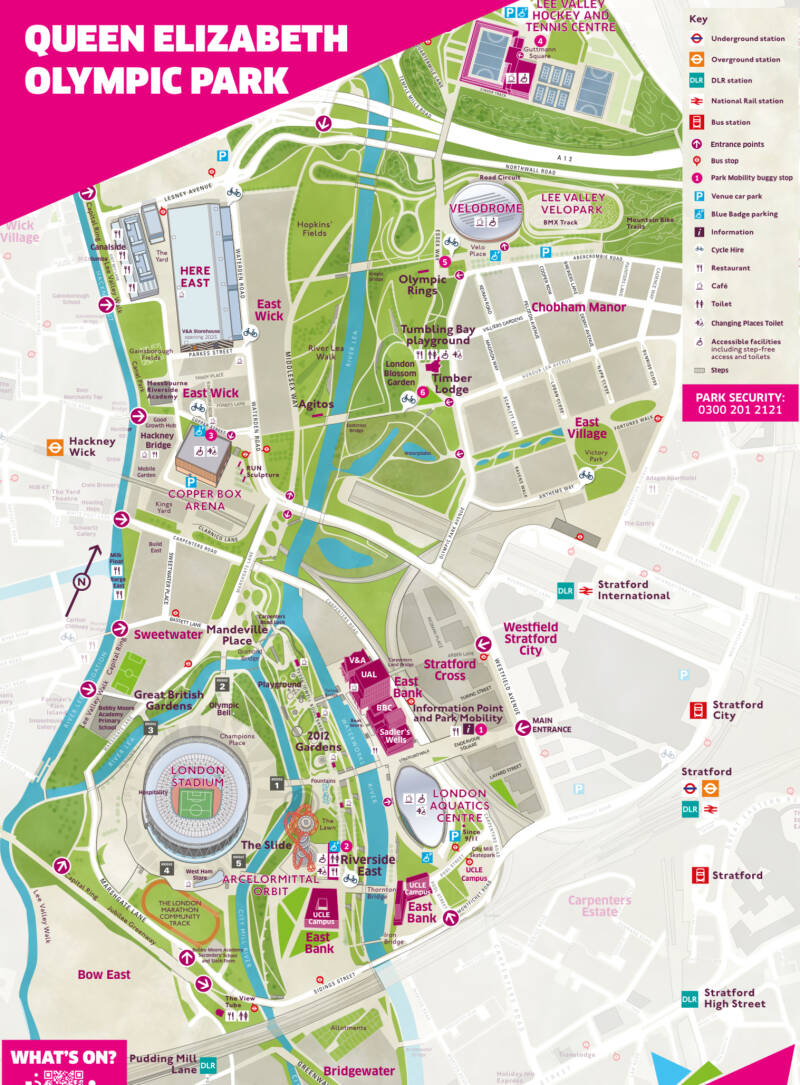
Then
EAST VILLAGE
It was designed and constructed as the Olympic Village of the 2012 Summer Olympics and has been converted for use as a new residential district, complete with independent shops, bars and restaurants.

MANHATTAN LOFT GARDENS
STRATFORD INTERNATIONAL Stations: railways and DLR

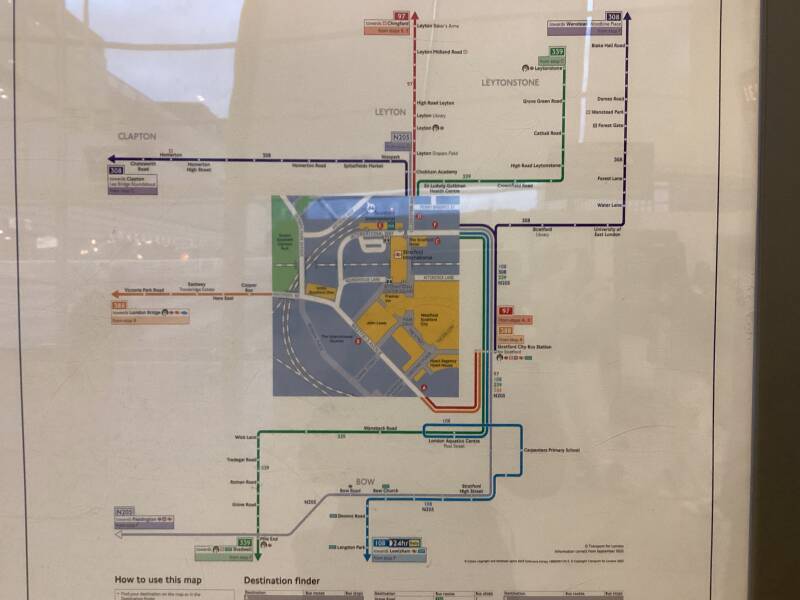

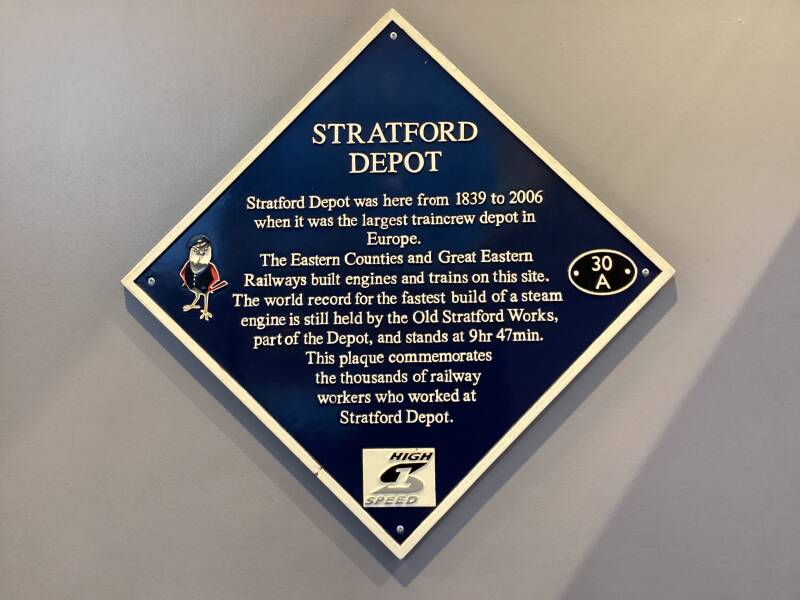
Site of STRATFORD WORKS, railway works
Seven minutes from ST.PANCRAS’s…

Currently no international trains stop at Stratford International station, despite its name and the platforms being built for them; Eurostar trains bypass it, but there are ongoing political and commercial efforts, including from new operator Gemini Trains, to introduce services starting around 2029. The station serves Southeastern high-speed domestic routes to Kent
WESTFIELD SHOPPING CENTRE
The first major Westfield shopping centre in London is Westfield London, located in White City/Shepherd's Bush, which opened on October 30, 2008, becoming London's largest shopping mall at the time with hundreds of stores, restaurants, and a cinema, built on the site of the 1908 Franco-British Exhibition. It was followed by Westfield Stratford City in East London, opening in 2011.


Due North: From the FOX CONNAUGHT (ROYAL DOCKS) to PLAISTOW and on to WEST HAM PARK and STRATFORD
FOX CONNAUGHT Restaurant & Hotel
CUSTOM HOUSE district
The area is named after the custom house of Royal Victoria Dock. originally part of the ancient parish and County Borough of West Ham,
The area became notorious for its poverty and slum conditions and its housing was almost entirely replaced by council flats after the Second World War, notably in the form of the Freemasons estate. Among the estate’s nine tower blocks was Ronan Point, which partially collapsed after a gas explosion in 1968, killing four people.
The ward of Custom House has a significant black African community, mainly speaking Yoruba, Twi and Swahili. Fifteen per cent of homes in the ward are lone parent households with dependent children
Across Victoria Dock Road
Allotments
Baxter Road
Church of the ASCENSION, VICTORIA DOCK
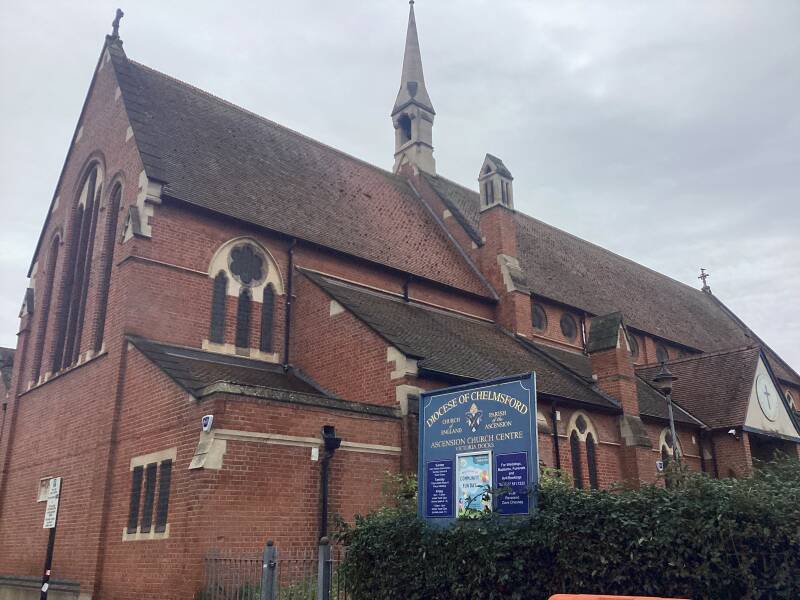

CAP DE TA FOI
It was first built in 1887 as a mission hall for St Luke's Church, later put under the charge of the Felsted School Mission, which prior to that had been working in Bromley. Between 1903 and 1907 a new church was built, with a separate parish split from St Luke's in 1905. The new parish opened a mission house for women workers in 1909.
From about 1924 writer Mabel Knowles led the St Luke's Mission Church in London's Victoria Docks. Knowles wrote more than 300 books during her life. She continued for leading the mission for 25 years, dying while preparing a mission service for women on 29 November 1949.
During the Second World War clergy from the Church of the Ascension also served Sandon parish near Chelmsford, since its rector Eric Leicester Andrews had been captured by the Japanese during the fall of Singapore in 1942. In 1961 the Church of the Ascension took on the area covered by the parish of St Matthew's Church, Custom House, which had been closed and deconsecrated the previous year.

You are very close to GEORGE V PARK and BECKTON DISTRICT PARK, for the route to Green Street
Young Road
Site of the West Ham SPEEDWAY and GREYHOUND RACING TRACK. Now residential estate.
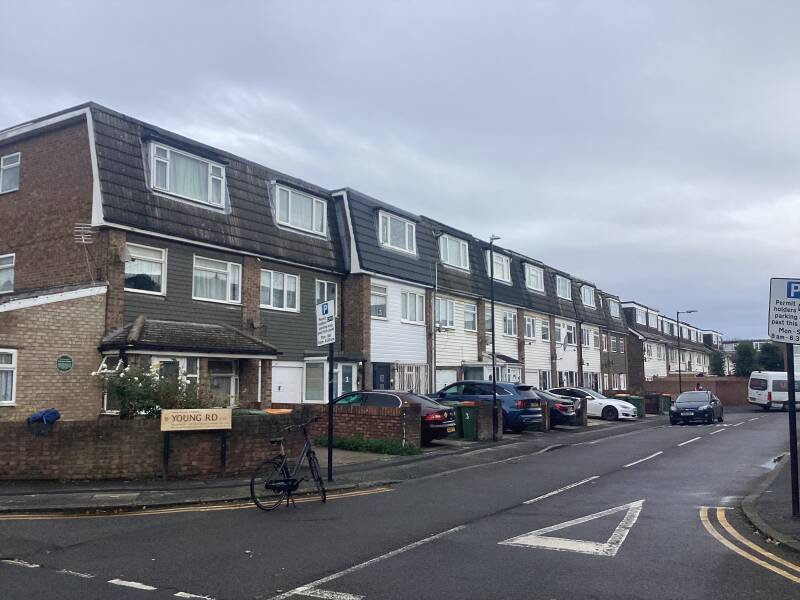
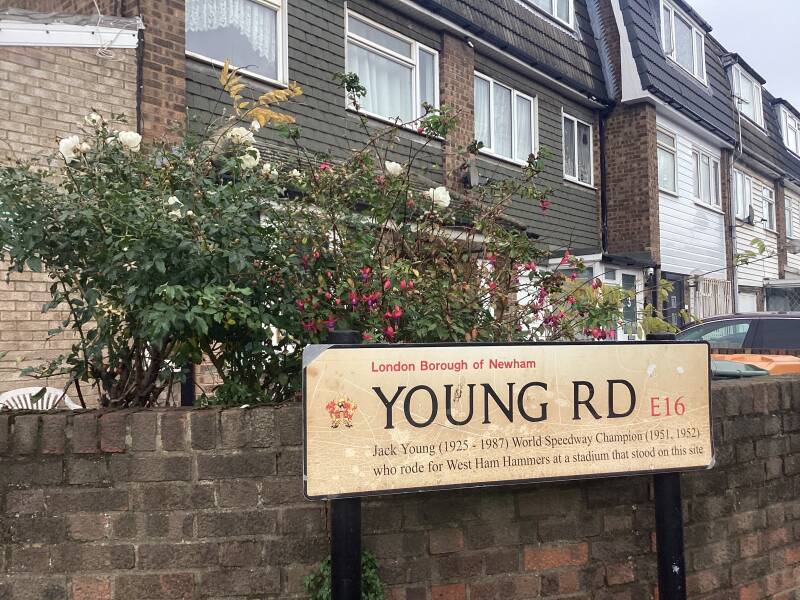
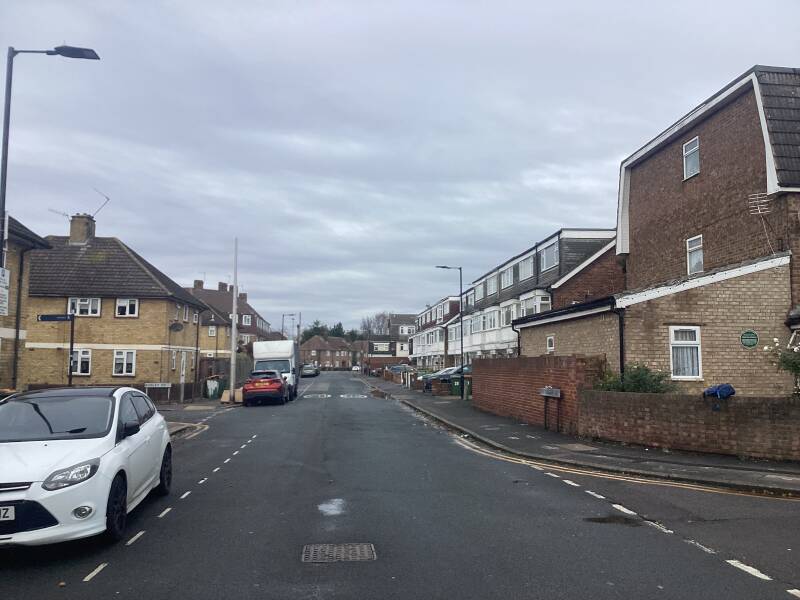
On this site stood West Ham Stadium where 85000 speedway fans watched England beat Australia in 1933 and greyhound legend "Mick the Miller" set a world record in 1930.
London Borough of Newham
Heritage Project
replaced by a maze of curling cul-de-sacs after its demolition in the 1970s. This part of Custom House is also known as West Beckton and many of its streets are named after former speedway champions
Prince Regent Road
CANNING TOWN RECREATION GROUND
CUSTOM HOUSE LIBRARY
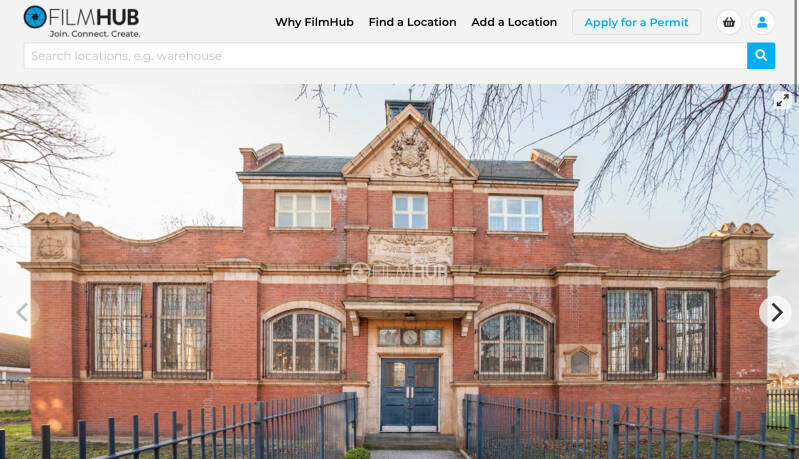
On the front of the Custom House Public Library in Prince Regent Lane. Two of the symbols on the shield link with the Silvertown area, The sailing ship top right is symbolises the docks. While the crossed hammers represent shipbuilding.

Across the Park, Westwards
Freemasons Road
Convenience stores and eateries
Underpass (Newham Way)
Newham Way (part of the A13)
evolved from ancient paths and industrial needs, becoming a major bypass in the 1930s/60s, while Beckton was defined by massive gasworks, with roads like Beckton Road and Tollgate Road developing to serve its docks and industry, linking historic areas like Plaistow (formerly West Ham) to the industrial powerhouse, all eventually integrated into the modern A13 corridor that transformed rural Essex into industrial East London.
CANNING TOWN: Area of VICTORIAN TERRACES
Charles CHAPLIN and the MAHATMA GANDHI coincide bot of then in London: CHAPLIN GANDHI MEMORIAL GARDEN
CHARLES CHAPLIN, A LEFTIST?: https://history.msu.edu/files/2010/04/Sbardellati-and-Shaw.pdf
A Young Gandhi connection with this area of East London

Arnold Hills and Mahatma Gandhi had in common a shared commitment to vegetarianism and worked closely together on the executive committee of the London Vegetarian Society in the late 19th century.
Key aspects they shared include:
- Vegetarianism: Both men were committed vegetarians. Hills was the first President of the London Vegetarian Society (LVS), and the young Gandhi served on its executive committee while studying law in London. This shared belief was a foundational aspect of their association.
- Social Reform Interest: Gandhi demonstrated a keen interest in the welfare of London's impoverished communities, and Hills was a social reformer, founding a hospital and other clubs.
-
- Their working relationship developed during Gandhi's time as a law student in London (1888-1891). Gandhi noted that he learned much from his association with the people he met through the vegetarian movement.
Despite their commonalities, they had some differences, such as a disagreement over the LVS membership of a fellow committee member, Thomas Allinson, who promoted birth control methods that Hills found morally objectionable. Hills was also a wealthy industrialist and shipbuilder (founder of the Thames Ironworks) who later founded the West Ham United football club, a different background from Gandhi's.

Westwards:To Canning Town (Barking Road)

Barking Rd.
Eastwards: To Plaistow
FAIRBARN HALL. Former university settlement, now apartments
Grade-II Listed building in Newham was originally a Boys’ Club–one of the most successful in Europe in the 1930s–part of the Mansfield House University Settlement, founded by students of Oxford University in 1889. Whilst the heritage of Fairbairn Hall has been well documented and preserved there is a discrepancy between Fairbairn Hall’s recorded heritage and local knowledge. For example, locals no longer knowing what a Boys’ Club is. (Or was). Or that Canning Town has deep ties to Mansfield College, University of Oxford and the Settlement Movement in East London. Or that Fairbairn Hall is the work of the celebrated architect G. Grey Wornum, who is best known for designing the RIBA on 66 Portland Place in London, and the Queen Elizabeth Ocean Liner.
ACCOMMODATION https://www.modernistestates.com/homes/fairbairn-hall
THE ABBEY ARMS P.H.
On the corner of New Barn Street and Barking Road. This wrought iron sign saying PRIVATE BAR & JUGS is over the entrance of the Abbey Arms in New Barn Street. Some customers brought their own jugs to be filled and taken away. This was a common practice for women who did not want to drink in the bar to take away a jug of beer and drink it at home, particularly as it was cheaper when sold by the jug. This pub was rebuilt in 1882. The name of the pub derives from the fact that Stratford Longthorne Abbey once owned much of the land in the area
MEMORIAL CHURCH
Greengate
Greengate Street in Plaistow likely gets its name from being the old road to "Hook End," a lost hamlet near a green, with "Greengate" referring to a gate near this green space or possibly linking to the historic "Green" area of Plaistow itself
Two early 16th century rentals of the abbey's land provide much topographical information about West Ham. (fn. 29)The main settlements were in Church Street (West Ham village), Stratford, and Plaistow. Plaistow first appears in records in 1414. (fn. 30) Its name, and the shape of the old village, suggest settlement around a village green or place of 'play'. The rentals also contain a few references to Upton, in the east of the parish, but, though that name had been recorded as early as the 13th century, (fn. 31) there was no substantial settlement there. Stratford, Plaistow, and Upton are still well-known names, but one hamlet often mentioned in the rentals has left no trace on modern maps. That was Hook End, which lay about a mile south-east of Plaistow village, at the end of Greengate Street. There are occasional references to Hook End down to the 19th century, and as late as 1869 the north end of the present Tunmarsh Lane was known as Hook End Lane. (fn. 32)
A TUDOR BUILDING?:
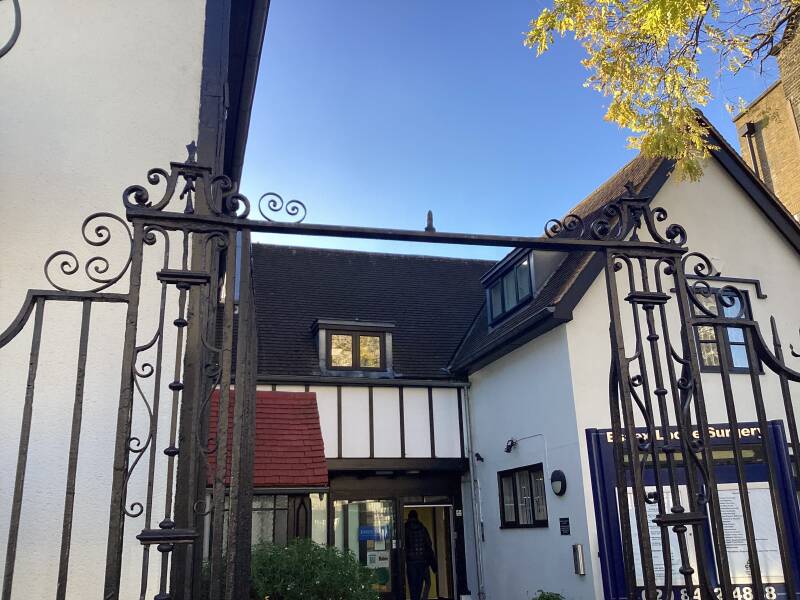
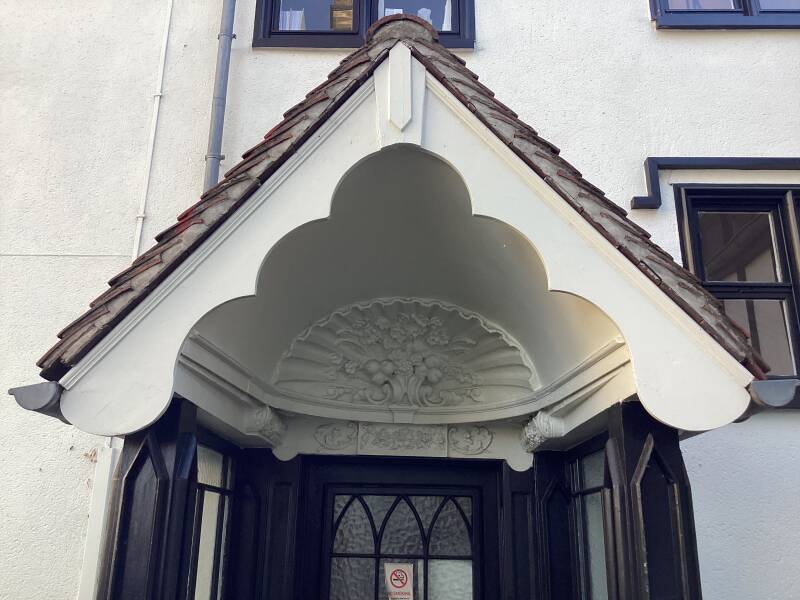
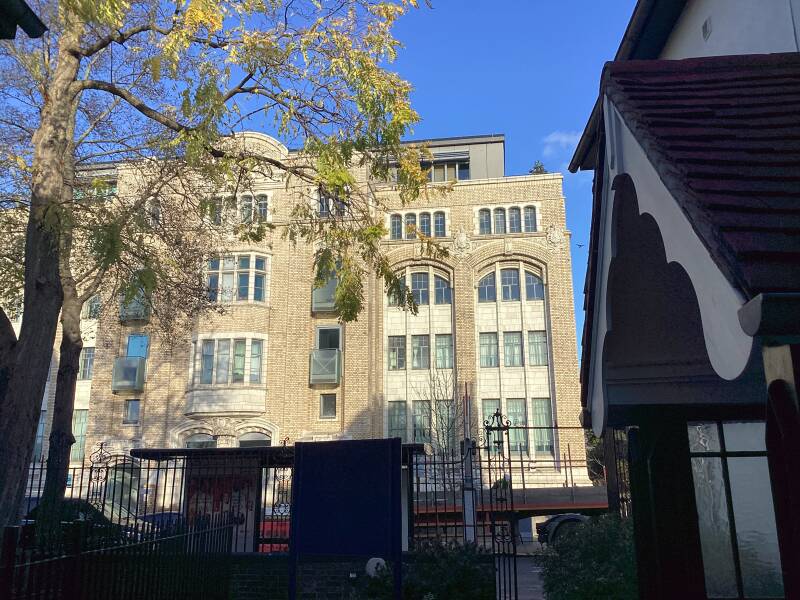
House. c.1840. Incorporates fragments of late 17th or early 18th century Essex House. Rendered walls; red tile pitched roof. Tudor style. Basement and 3 storeys. Two windows wide to ground and first floors. One window in gable to road. Square headed windows with drip mouldings. Ornamental bargeboards to gable. Items from Essex House include: richly carved shell-hooded entrance (within later gabled porch on north elevation), early 18th century wrought iron boundary railings and gateway, with lampholder. Good stone corniced chimney-piece with bold architrave, voussoirs and keyblock, bearing crest of Willyams family. (Victoria History of County of Essex Vol VI, page 51.
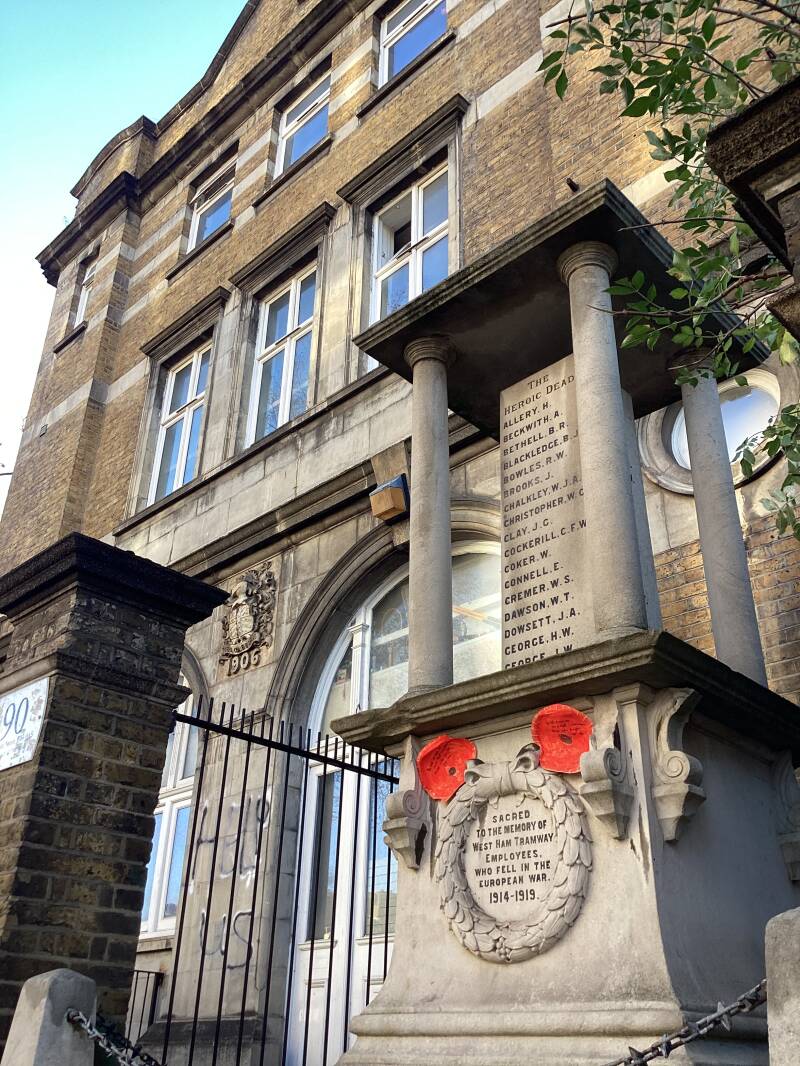
Former TRAM OFFICES (a the rear, the former DEPOT)

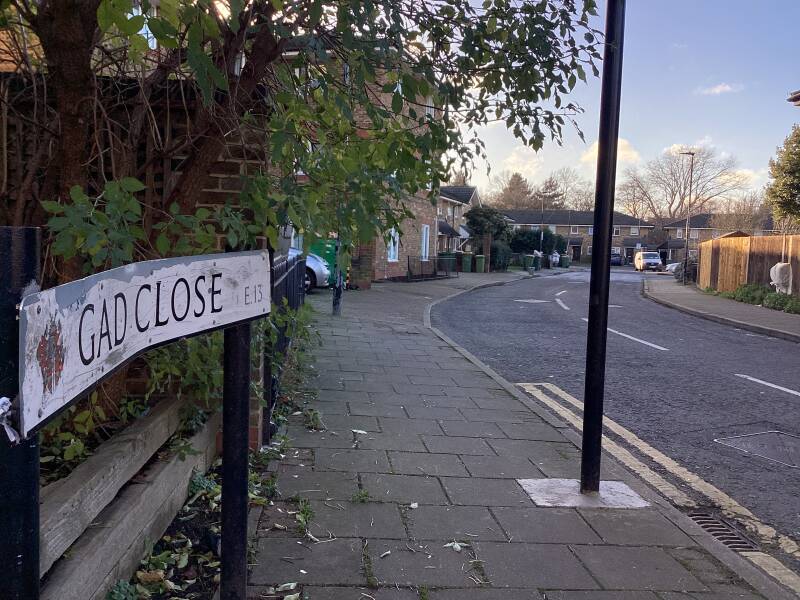
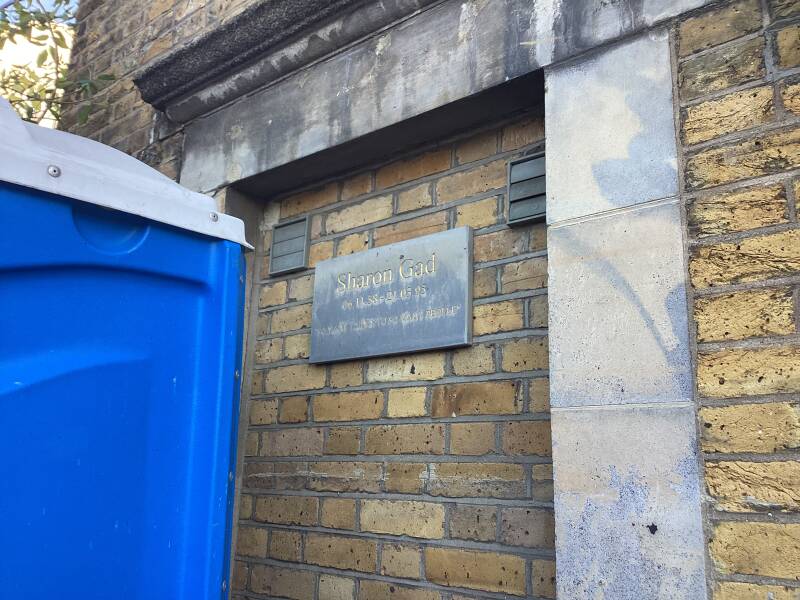
Gad Close?. SHARON GAD
A former Y.M.C.A
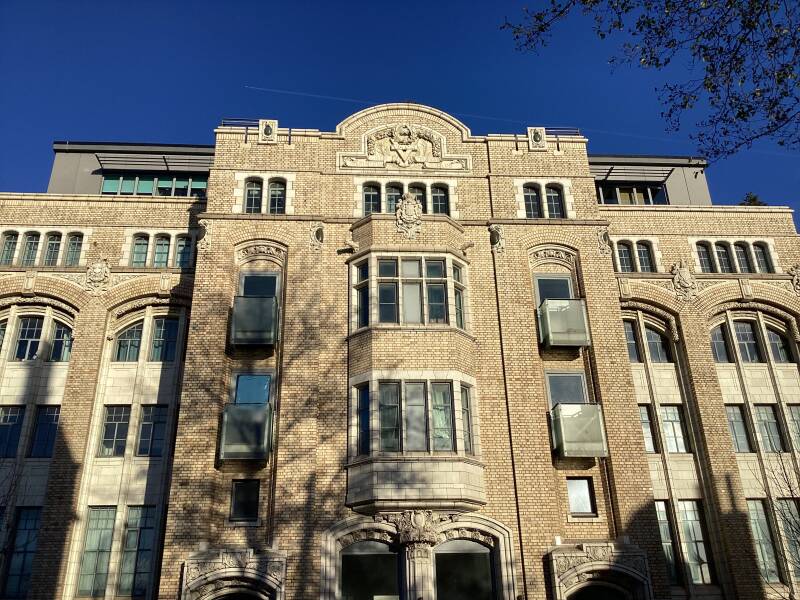
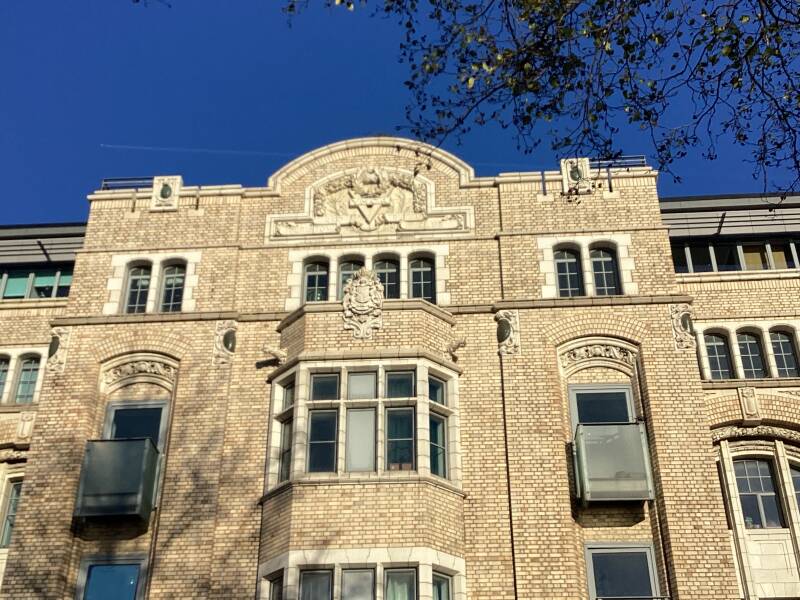
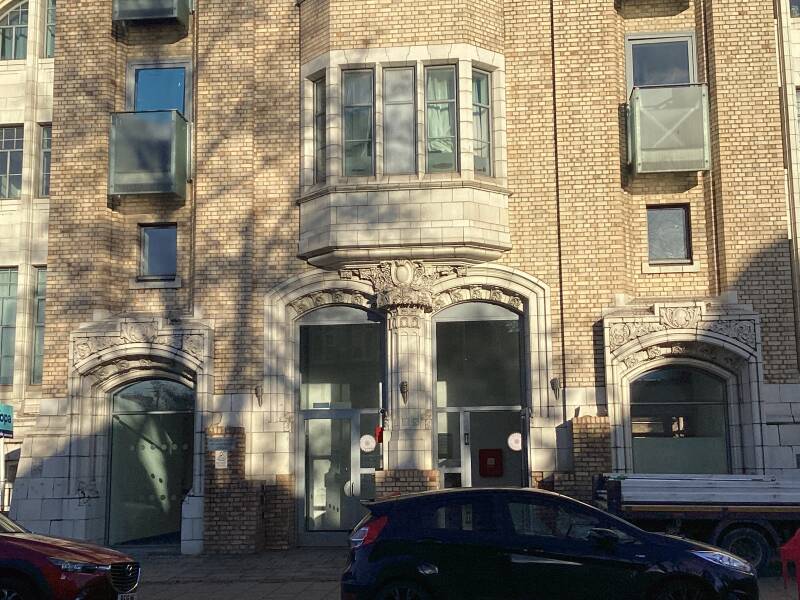
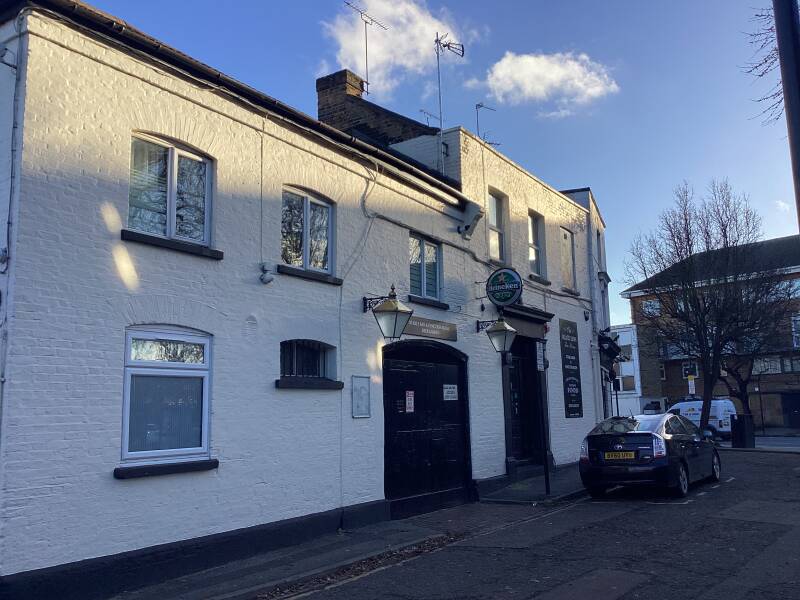
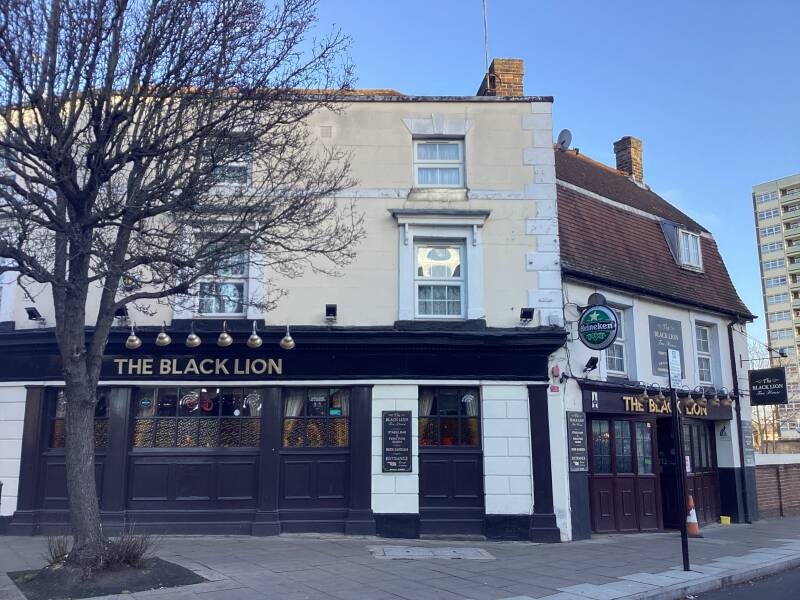
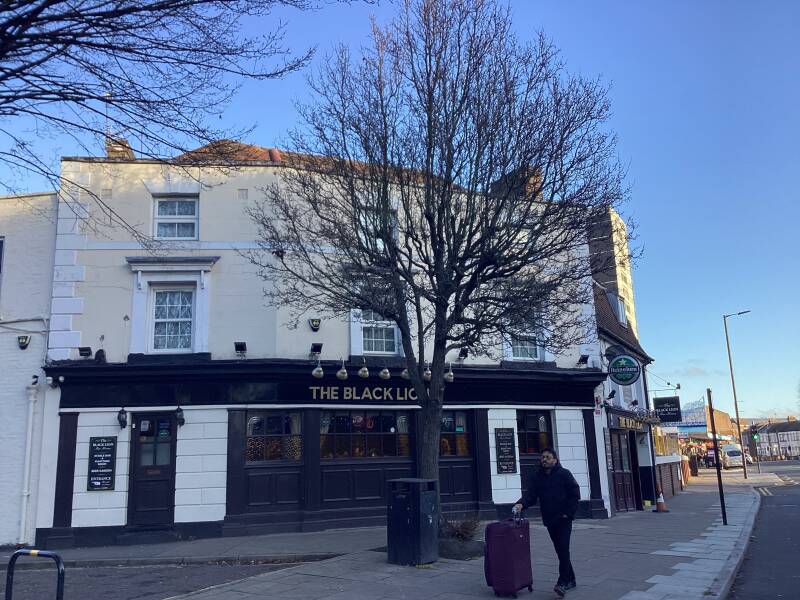
A former haunt of DICK TURPIN and BOBBY MOORE

Richmond St.
Pelly Rd.

Same route as before up to the Olympic Park
Stratford Rd
A piece of Rotherhithe in West Ham

